Oil Painting » List of Painters » Adam Elsheimer
EARLY DAYS:
Adam Elsheimer (1578-1610) was a German-born artist who is considered to be one of the most influential and important artists of the Baroque period. He was born in Frankfurt, Germany, and began his artistic career in his hometown, studying painting under the court artist and engraver Georg Hainz. Elsheimer was known for his small scale, intimate works, often depicting religious scenes and classical mythology. He also had a great interest in landscape painting, and his works often depicted the natural world in a realistic and detailed way.
Elsheimer's early works show a great influence from his teacher, Hainz. Many of his paintings from this period depict religious scenes, such as his 1596 painting of the Virgin and Child with St. Catherine and St. Elisabeth. He also produced several small-scale works depicting classical mythology, such as his painting of Medea and Jason from around 1599. During this early period, Elsheimer was known for his skill in miniature painting, often creating works on copper panels measuring no more than 15 by 20 centimeters.

Personal Details
| Name | Adam Elsheimer |
| Place of birth | Frankfurt-am-Main,Germany |
| Date of Birth | March 18,1578 |
| Date of Death | December 11,1610 |
| Nationality | German |
| Field | Cabinet Paintings |
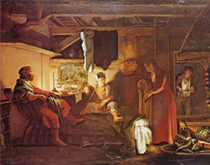
| Popular Works | Jupiter & Mercury in the house of Philemon & Baucis,Tobias and Angel |
In 1600, Elsheimer moved to Rome, Italy. There, he struck up a friendship with the scientist and astronomer Galileo Galilei, who introduced him to the world of astronomy. This would later become a major influence on Elsheimer's work, as he began to incorporate astronomical elements into his works. One of Elsheimer's most famous works, The Flight into Egypt was painted in 1609 and is filled with astronomy references, such as depictions of the stars and planets.
Elsheimer's works from his time in Rome show a great influence from the Italian Renaissance masters, such as Raphael and Correggio. His paintings often featured a soft, luminous light, and his landscapes were filled with detailed renderings of trees and foliage. Elsheimer's compositions were often complex, with multiple figures and elements arranged in a dynamic and dramatic way.
Elsheimer died in Rome in 1610 at the age of 32. He left behind a body of work that had a major influence on Baroque art and several generations of artists that followed. His small scale works, detailed landscapes, and innovative use of astronomy, are all still admired today.
CAREER:
Adam Elsheimer is known for his small-scale Baroque compositions, which often featured landscapes and night scenes with moonlit skies and nocturnal elements. Elsheimer was largely self-taught, and his style was heavily influenced by the work of Caravaggio and the Netherlandish painter, Joos de Momper.
Esheimer's career began with religious painting, but he soon moved into secular works, especially landscapes and nocturnes with stars and the moon. His early works follow a traditional style of religious painting, but his later works have a unique style that combines the techniques of Caravaggio with the Netherlandish tradition of painting night scenes. His most famous works include The Flight into Egypt (1609), The Finding of Moses (1609), and The Adoration of the Shepherds (1609).
Elsheimer's fame spread throughout Europe during his lifetime, and his works were highly sought after by royalty and the nobility. He was invited to the court of Rudolf II in Prague, where he was given a room in the castle and a large salary. It was at this court that Elsheimer made many of his most famous works, such as The Flight into Egypt and The Finding of Moses.
In 1612, Elsheimer moved to Rome, where he became a member of the Accademia di San Luca. He quickly gained recognition as one of the most talented artists in the city, and he was highly sought after by patrons. He was commissioned to create works for Pope Paul V and Cardinal Scipione Borghese, and his works were displayed in the Vatican.
Elsheimer also became friends with Galileo Galilei, who was a great admirer of his work. The two men often discussed astronomy and the heavens, and Galileo was said to have used some of Elsheimer's paintings of the night sky as inspiration for his own work.
In 1610, Elsheimer was suddenly stricken with an illness, and he died at the age of 32. He left behind a legacy of beautiful, highly detailed works of art that continue to be admired and studied by art historians and fans of Baroque art.
Although Elsheimer's career was short-lived, his influence on the Baroque style of painting was immense. His works combine the techniques of Caravaggio and the Netherlandish tradition of painting night scenes, and his use of light and shadow gave his works an ethereal quality that was unique for the time. His works are still studied and appreciated today, and his influence can be seen in the works of many modern painters.
WORKS OF ADAM ELSHMER