| |
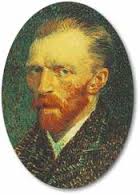
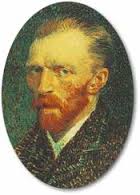
Vincent van Gogh
Vincent Willem van Gogh (March 30, 1853 – July 29, 1890)
was a Dutch painter, generally considered one of the greatest painters
in European art history. He produced all of his work (some 900 paintings
and 1100 drawings) during a period of only ten years before he became
mentally ill (possibly bipolar disorder) and committed suicide.
He had little success during his lifetime, but his posthumous fame
grew rapidly, especially following a showing of 71 of van Gogh's
paintings in Paris on March 17, 1901 (11 years after his death).
Van Gogh's influence on expressionism, fauvism and early abstraction
was enormous, and can be seen in many other aspects of 20th-century
art. The Van Gogh Museum in Amsterdam is dedicated to Van Gogh's
work and that of his contemporaries. The Kröller-Müller
Museum in Otterlo (also in the Netherlands), has a considerable
collection of Vincent van Gogh paintings as well. Several paintings
by Van Gogh rank among the most expensive paintings in the world.
On March 30, 1987, van Gogh's painting Irises was sold for a record
US$53.9 million at Sotheby's; on May 15, 1990, his Portrait of Doctor
Gachet was sold for $82.5 million at Christie's, thus establishing
a new price record.
Life and work
Vincent was born in Zundert, the son of Anna Cornelia Carbentus
and Theodorus van Gogh, a Protestant minister. Van Gogh found his
father's profession appealing and would be drawn to it later in
his life. His sister described him as serious and introspective.
At age 16, van Gogh started to work for the art dealer Goupilator
& Company in the Hague. His brother Theo, four years his junior
and with whom Vincent cherished a lifelong friendship, would join
the company later. This friendship is amply documented in the large
collection of letters they sent each other. These letters have been
preserved and were published in 1914. They provide much insight
into the life of the painter, and show him to be a talented writer
with a keen mind. Theo would support Vincent financially throughout
his life.
In 1873, his firm transferred him to London (where he lodged in
Stockwell), then to Paris. He became increasingly interested in
religion; in 1876, Goupil dismissed him for lack of motivation.
He became a teaching assistant in Ramsgate in Kent, England, then
returned to Amsterdam to study theology in 1877.
After dropping out in 1878, he became a lay minister in Belgium
in a poor mining region known as the Borinage. He even preached
down in the mines and was extremely concerned with the lot of the
workers. He was dismissed after six months and continued without
pay. During this period he started to produce charcoal sketches.
The Potato Eaters (1885)In 1880, Vincent followed the suggestion
of his brother Theo and took up painting in earnest. For a brief
period Vincent took painting lessons from Anton Mauve at the Hague.
Although Vincent and Anton soon split over a divergence of artistic
views, influences of the Hague School of painting would remain in
Vincent's work, notably in the way he played with light and in the
looseness of his brush strokes. However his usage of colour, favouring
dark tones, set him apart from his teacher.
In 1881, he declared his love to his widowed cousin Kee Vos, who
rejected him. Later he would move in with the prostitute Sien Hoornik
and her children and considered marrying her; his father was strictly
against this relationship and even his brother Theo advised against
it. They later separated.
Impressed and influenced by Jean-François Millet, van Gogh
focused on painting peasants and rural scenes. He moved to the Dutch
province Drenthe, later to Nuenen, North Brabant, also in the Netherlands.
Here he painted in 1885 The Potato Eaters (Dutch Aardappeleters,
now in The Van Gogh Museum in Amsterdam).
In the winter of 1885–1886, Van Gogh attended the art academy
of Antwerp. This proved a disappointment, as he was dismissed after
a few months by Professor Eugène Siberdt. Van Gogh did, however,
become familiar with Japanese art during this period, which he started
to collect eagerly. He admired its bright colours, use of canvas
space and the role lines played in the picture. These impressions
would influence him strongly. Van Gogh made some paintings in Japanese
style. Also some of the portraits he painted are set against a background
which shows Japanese art.
Sunflowers painted at Arles, 1888 (Neue Pinakothek, Munich)In
spring 1886, Van Gogh went to Paris, where he moved in with his
brother Theo; they shared a house on Montmartre. Here he met the
painters Edgar Degas, Camille Pissarro, Emile Bernard, Henri de
Toulouse-Lautrec and Paul Gauguin. He discovered impressionism and
liked its use of light and colour, more than its lack of social
engagement (as he saw it). (It should be noted that Van Gogh is
regarded as a post-impressionist, rather than an impressionist.)
He especially liked the technique known as pointillism (where many
small dots are applied to the canvas that blend into rich colours
only in the eye of the beholder, seeing it from a distance) made
its mark on Van Gogh's own style. Van Gogh also used complementary
colours, especially blue and orange, in close proximity in order
to enhance the brilliance of each. A lovely quote from one of his
letters: "I want to use colours that complement each other,
that cause each other to shine brilliantly, that complete each other
like a man and a woman."
Cafe Terrace at Night (1888)In 1888, when city life and living
with his brother proved too much, Van Gogh left Paris and went to
Arles, Bouches-du-Rhône, France. He was impressed with the
local landscape and hoped to found an art colony. He decorated a
"yellow house" and created a celebrated series of yellow
sunflower paintings for this purpose. Only Paul Gauguin, whose simplified
colour schemes and forms (known as synthetism) attracted van Gogh,
followed his invitation. The admiration was mutual, and Gauguin
painted van Gogh painting sunflowers. However their encounter ended
in a quarrel. Van Gogh suffered a mental breakdown (possibly induced
by absinthe) and cut off part of his left ear, which he gave to
a startled prostitute friend. Gauguin left in December 1888.
One of Vincent's famous paintings, the Bedroom in Arles, uses bright
yellow and unusual perspective effects in depicting the interior
of his bedroom. The boldly vanishing lines are sometimes attributed
to his changing mental condition. The only painting he sold during
his lifetime, The Red Vineyard, was created in 1888. It is now on
display in the Pushkin Museum in Moscow, Russia.
The Red Vineyard (1888)Van Gogh now exchanged painting dots for
small stripes. He suffered from depression, and in 1889 on his own
request Van Gogh was admitted to the psychiatric centre at Monastery
Saint-Paul de Mausole in Saint Remy de Provence, Bouches-du-Rhône,
France. During his stay here the clinic and its garden became his
main subject. At this time his work began to be dominated by swirls.
This is especially shown in his most famous painting, The Starry
Night.
In May 1890, Vincent left the clinic and went to the physician
Paul Gachet, in Auvers-sur-Oise near Paris, where he was closer
to his brother Theo, who had recently married. Gachet had been recommended
to him by Pissarro; he had treated several artists before. Here
van Gogh created his only etching: a portrait of the melancholic
doctor Gachet. His depression deepened, and on July 27, at the age
of 37, van Gogh shot himself in the chest. Without realising that
he was fatally wounded, he returned to the Ravoux Inn, where he
died two days later, with Theo at his side, who reported his last
words as "La tristesse durera toujours" (French for "the
sadness will last forever"). He was buried at the cemetery
of Auvers-sur-Oise; Theo, unable to come to terms with his brother's
death, died six months later and, at his wife's request, was buried
next to Vincent. While many have mistakenly thought that Wheat Field
with Crows was van Gogh's last work before his suicide (because
of its turbulent style), it is more likely that van Gogh's last
work was Daubigny's Garden.
Van Gogh's fame grew shortly after his death. Large exhibitions
were organised in Paris (1901), Amsterdam (1905), Cologne (1912),
New York City (1913) and Berlin (1914).
Van Gogh's life forms the basis for Irving Stone's biographical
novel Lust for Life. In 1972, singer Don McLean wrote the ballad
"Vincent", also known as "Starry Starry Night"
(after his most known work), in honour of van Gogh.
The paintings are the excellent portrayal of the events and scenes
that we see around us. The painters are the best cameras of the
world. They reproduce many different types of pictures. They even
draw imaginary pictures that do not exist in this world. We tend
to use both thinned oil paints and dense oil paints. Masterpieces
can be dyed more than once, but each time it may be different from
the existing paintings.h
Sitemap
Painter sitemap
Techniques sitemap
Materials sitemap
famous paintings
| famous painters
| painting styles
| famous artists
| mixed media painting
| painting technique
| oil paintings |
canvas painting | life
oil painting still | abstract
art paintings | modern
art work | fine art
painting landscape | oil
painting reproductions - media | history
of paintings | oil
painting - idioms | review
painting articles | review
painting news
|
|
|