| |
Pablo Picasso
Pablo Picasso, formally Pablo Ruiz Picasso, (October 25, 1881 –
April 8, 1973) was one of the recognized masters of 20th century
art, probably most famous as the founder, along with Georges Braque,
of Cubism.
Introduction
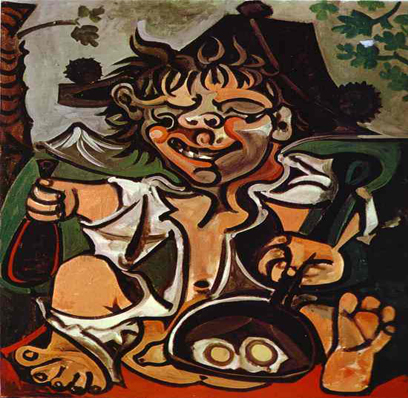
Picasso is most famous as the co-founder of Cubism. However, in
a long life he produced a wide and varied body of work, the best-known
being the Blue Period works which feature moving depictions of acrobats,
harlequins, prostitutes, beggars and artists.
While Picasso was primarily a painter (in fact he believed that
an artist must paint in order to be considered a true artist), he
also worked with small ceramic and bronze sculptures, collage and
even produced some poetry. "Je suis aussi un poète,"
as he quipped to his friends.
Picasso was the most prolific painter ever, as deemed in the Guiness
Book of Records. He produced about 13,500 paintings or designs,
100,000 prints or engravings, 34,000 book illustrations, and 300
sculptures and ceramics plus drawings and tapestries. The total
value of his work was estimated in 1973 to be about $750 million.
Arguably Picasso's most famous work is his depiction of the German
bombing of Guernica, Spain: Guernica. This large canvas embodies
for many the inhumanity, brutality and hopelessness of war. The
act of painting it was captured in a series of photographs by Picasso's
most famous lover, Dora Maar, a distinguished artist in her own
right. Guernica hung in New York's Museum of Modern Art for many
years; Picasso stipulated that the painting should not return to
Spain until democracy was restored in that country. In 1981 Guernica
was returned to Spain and exhibited at the Casón del Buen
Retiro. In 1992 the painting became one of the main attractions
in Madrid's Reina Sofía Museum when it opened.
Picasso was extremely talented as a painter and draughtsman, even
by the standards of the world's great artists. He worked with equal
facility in oil, watercolour, pastels, charcoal, pencil, and ink.
He famously rendered complex scenes as just a few geometric shapes
in his mixed-media Cubist works, but he also produced masterful
realist portraits throughout his life. His pen and ink sketches
of his friends from the Cubist era and afterwards are valued for
their understated intimacy, examples of the fluidity of his skills.
Indeed, Picasso moved with ease among the plastic arts despite limited
academic training (he finished only one year at the Royal Academy
in Madrid). His natural talents were augmented by a ferocious work
ethic that survived into the final years of his long life.
Periods
Picasso's work is often categorized into "Periods". While
the names of many of his later periods are debated, the most commonly
accepted periods in his work are:
Blue Period (1901-1904) - sombre paintings which are influenced
from a trip in Spain, his sad mood in many of the pictures possibly
coming from his reaction to the death of a friend.
Rose Period (1905-1907) - A more cheerful style in orange and pink
colours, which featured many harlequins. He met Fernande Oliver
in Paris and many of these paintings are influenced by his warm
relationship with her, and also from French painting.
African influenced Period (1908-09) - Influenced by the two figures
on the right in his painting of Les Demoiselles d'Avignon, he used
African artefacts as the inspiration for his work.
Analytical Cubism (1909-12) - A style of painting he developed along
with Braque using monochrome brownish colours, where they took apart
objects and 'analysed' them in terms of their shapes. Picasso's
and Braque's paintings at this time are very similar to each other.
Synthetic Cubism (1912-19) - Involving the use of collage and cut
paper, it was the first time collage had been used as a fine art
work.
Early life
Picador. Málaga, 1889-90. Oil on panel. Collection Claude
Picasso, Paris.Pablo Diego José Santiago Francisco de Paula
Juan Nepomuceno Crispín Crispiniano de los Remedios Cipriano
de la Santísima Trinidad Ruiz Picasso was born on October
25, 1881 in Málaga, Spain, the first child of José
Ruiz y Blasco and María Picasso y López.
Picasso's father, José Ruiz y Blasco, was himself a painter;
for most of his life, a professor of art at the School of Fine Arts
and Crafts; and was a curator of a local museum. It was from his
father that Picasso learned the basics of formal academic art training
– figure drawing, and painting in oil. Although Picasso attended
art schools throughout his childhood, often those where his father
taught, he never finished his college level course of study at the
Royal Academy of San Fernando in Madrid, leaving after less than
a year.
The Picasso Museum in Barcelona features many of Picasso's early
works, created while he was living in Spain, as well as the extensive
collection of Jaime Sabartés, Picasso's close friend from
his Barcelona days and for many years Picasso's personal secretary.
There are many precise and detailed figure studies done in his youth
under his father's tutelage, as well as rarely seen works from his
old age, that clearly demonstrate Picasso's firm grounding in classical
techniques.
Picasso used the harlequin in many of his early works, especially
in his Blue and Rose Periods. A comedic character depicted usually
in checkered patterned clothing, the harlequin became a personal
symbol of Picasso. During the 1930s, the minotaur replaced the harlequin
as a motif which he used often in his work. His use of the minotaur
came partly because of contact with the Surrealists who often used
it as their symbol. The minotaur appears in Picasso's painting Guernica.
Picasso and pacifism
Picasso remained neutral during the Spanish Civil War, World War
I and World War II, refusing to fight for any side or country. Picasso
never commented on this but encouraged the idea that it was because
he was a pacifist. Some of his contemporaries though (including
Braque) felt that this neutrality had more to do with cowardice
than principle.
As a Spanish citizen living in France, Picasso was under no compulsion
to fight against the invading Germans in either world war. In the
Spanish Civil War, service for Spaniards living abroad was optional
and would have involved a voluntary return to the country to join
either side. While Picasso expressed anger and condemnation of Franco
and the Fascists through his art he did not take up arms against
them.
He also remained aloof from the Catalan independence movement during
his youth despite expressing general support and being friendly
with activists within it. No political movement seemed to compel
his support to any great degree.
During the Second World War, Picasso lived in German occupied Paris.
The Nazis hated his style of painting, so he was not able to show
his works during this time. He retreated into his studio, continuing
to paint nevertheless. While the Germans outlawed bronze casting
in Paris, Picasso was still able to continue because of the French
resistance who would smuggle bronze to him.
After the Second World War, Picasso rejoined the French Communist
Party, and even attended an international peace conference in Poland.
But party criticism of a portrait of Stalin as insufficiently realistic
cooled Picasso's interest in Communist politics, though he remained
a loyal member of the Communist Party until his death.
Personal life
(left to right) Manuel Ortiz de Zárate, Henri-Pierre Roché
(in uniform), Marie Vassilieff, Max Jacob and Pablo Picasso. (1915)Picasso
hated to be alone when he wasn't working. In Paris, in addition
to having a distinguished coterie of friends in the Montmartre and
Montparnasse quarters, including André Breton, Guillaume
Apollinaire, writer Gertrude Stein and others, he usually maintained
a number of mistresses in addition to his wife or primary partner.
Picasso married twice and had four children by three women.
In the early years of the 20th century, Picasso, still a struggling
youth, began a long term relationship with Fernande Olivier. It
is she who appears in many of the Rose period paintings. After garnering
fame and some fortune, Picasso left Fernande for Marcelle Humbert,
whom Picasso called Eva. Picasso included declarations of his love
for Eva in many Cubist works. Eva was diagnosed with cancer and
during her rapid deterioration, Picasso administered to her every
need, making daily trips across Paris to visit her in the hospital.
Nu couché aux fleurs (1932)In 1918, Picasso married Olga
Khoklova, a ballerina with Sergei Diaghilev's troupe, for whom Picasso
was designing a ballet, Parade, in Rome. Olga introduced Picasso
to high society, formal dinner parties, and all the social niceties
attendant on the life of the rich in 1920s Paris. The two had a
son, Paulo, who would grow up to be a dissolute motorcycle racer
and chauffeur to his father.
Olga's insistence on social propriety clashed with Picasso's bohemian
tendencies and the two lived in a state of constant conflict. In
1927 Picasso met 17 year old Marie-Thérèse Walter
and began a secret affair with her. Picasso's marriage to Olga soon
ended in separation rather than divorce, as French law required
an even division of property in the case of divorce and Picasso
did not want Olga to have half his wealth. The two remained legally
married until Olga's death in 1955.
Picasso carried on a long-standing affair with Marie Thérèse
and fathered a daughter, Maya, with her. Marie Thérèse
lived in the vain hope that Picasso would one day marry her and
eventually hanged herself after Picasso's death.
The photographer and painter Dora Maar was also a constant companion
and lover of Picasso. The two were closest in the late 30s and early
40s and it was Dora who documented the painting of Guernica. Like
all the women in his life, Dora was cruelly emotionally abused by
the narcissistic Picasso.
After the liberation of Paris in 1944, Picasso began to keep company
with a young art student, Françoise Gilot. The two eventually
became lovers, and had two children together, Claude, and Paloma.
Uniquely among Picasso's women, Françoise eventually left
Picasso in 1953 because of his abusive treatment and infidelities.
This came as a severe blow to Picasso.
He went through a difficult period after Françoise's departure,
coming to terms with his advancing age and his perception that he
was an old man, now in his seventies, who was no longer attractive,
but rather grotesque to young women. A number of ink drawings from
this period explore this theme of the hideous old dwarf as buffoonish
counterpoint to the beautiful young girl, including several from
a six-week affair with Geneviève Laporte, who in June 2005
auctioned off the drawings Picasso made of her.
Picasso was not long in finding another lover, Jacqueline Roque.
Jacqueline worked at the Madoura Pottery, where Picasso made and
painted ceramics. The two remained together for the rest of Picasso's
life, marrying in 1961. Their marriage was also the means of one
last act of revenge against Françoise. Françoise had
been seeking a legal means to legitimize her children with Picasso,
Claude and Paloma. With Picasso's encouragement, she had arranged
to divorce her then husband, Luc Simon, and marry Picasso to secure
her children's rights. Picasso then secretly married Jacqueline
after Françoise had filed for divorce in order to exact his
revenge for her leaving him.
In addition to his manifold artistic accomplishments, Picasso had
a film career, including a cameo appearance in Jean Cocteau's "Testament
of Orpheus". Picasso always played himself in his film appearances.
For a list of quotations by Pablo Picasso, see Pablo Picasso/Quotations
Later works
Picasso sculpture in Chicago, IllinoisIn the 1950s his style changed
once again as he began looking at the art of the great masters,
and making new art about it. He made a series of works based on
Velazquez's painting of Las Meninas. He also based paintings on
works on art by Goya, Poussin, Manet, Courbet and Delacroix. During
this time he lived at Cannes and in 1955 helped make the film Le
Mystère Picasso (The Mystery of Picasso) directed by Henri-Georges
Clouzot.
Picasso had accumulated a huge fortune and could afford large villas
in the south of France, at Notre-dame-de-vie on the outskirts of
Mougins, in the Provence-Alpes-Côte d'Azur. The media would
give him much attention, though they were often more interested
in his personal life than his art.
He was commissioned to make a maquette for a huge 50 foot high
sculpture to be built in Chicago, Illinois, known usually as the
Chicago Picasso. He approached the project with a great deal of
enthusiasm, designing a sculpture which was ambiguous and became
somewhat controversial. What the figure is exactly is not known;
it could be a bird, a horse, a woman or a totally abstract shape.
The sculpture, one of the most recognizable landmarks of downtown
Chicago was unveiled in 1967. Picasso refused to be paid $100,000
for it, donating it to the people of Chicago.
In his 80s and 90s, Picasso, no longer quite the energetic dynamo
he had been in his youth, became more and more impotent. To a man
for whom this was such an important part of life, this was a serious
life change and Picasso seems to have dealt with it by redoubling
his already prolific artistic output.
Picasso's final works were a mixture of styles, his styles and
periods changing right until the end of his life. Devoting his full
energies to his work, Picasso became more daring, his works more
colourful and expressive, and from 1968 through 1971 he produced
a torrent of paintings and hundreds of copperplate engravings. At
the time these works were dismissed by most as pornographic fantasies
of an impotent old man or the slapdash works of an artist who was
past his prime. One long time admirer, Douglas Cooper, called them
"the incoherent scribblings of a frenetic old man". Only
later, after Picasso's death, when the rest of the art world had
moved on from abstract expressionism, did the critical community
come to see that Picasso had already discovered neo-expressionism
and was, as usual, ahead of his time.
Pablo Picasso died on April 8, 1973, and was interred at Castle
Vauvenargues' park, in Vauvenargues, Bouches-du-Rhône. Jacqueline
prevented his children Claude and Paloma from attending the funeral.
His final words were "drink to me".
At the time of his death, he had kept off the art market that which
he had not needed to sell. In addition, Picasso had a considerable
collection of the work of other famous artists, some his contemporaries,
such as Henri Matisse, with whom he had exchanged works. Since Picasso
left no will, his death duties, or estate tax to the French state,
were paid in the form of his works and others from his collection.
These works form the core of the immense and representative collection
of the Musée Picasso in Paris. In 2003, relatives of Picasso
inaugurated a museum dedicated to him in his birthplace, Málaga,
Spain, the Museo Picasso Málaga.
The paintings are the excellent portrayal of the events and scenes
that we see around us. The painters are the best cameras of the
world. They reproduce many different types of pictures. They even
draw imaginary pictures that do not exist in this world. We tend
to use both thinned oil paints and dense oil paints. Masterpieces
can be dyed more than once, but each time it may be different from
the existing paintings.h
|
|
|
|
|
| |
| | | | | | | | | | | | |
|
|
|