Oil Painting » List of Painters » Aelbert Jacobsz Cuyp
EARLY DAYS:
Aelbert Jacobsz Cuyp was a Dutch Baroque-era painter, born in the city of Dordrecht in 1620. Cuyp was one of the most important painters of the Dutch Golden Age and his works are renowned for their brilliant colours and exquisite detail. Cuyp's early works display a mastery of Dutch landscape painting, and his later works demonstrate a more expressive style.
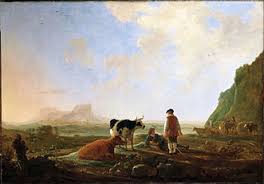
As a young man, Cuyp was apprenticed to his father, an art dealer and painter. He received his first formal training in art from his father, and was exposed to the works of the leading painters of the day, such as Rembrandt and Jan van Goyen. Cuyp's early works were small-scale landscapes, depicting the everyday scenes of Dutch life such as windmills, boats, and market scenes. He also painted portraits and religious works.
Cuyp's early works demonstrate his skill in the use of light and shade and his ability to capture the atmosphere of his subjects. His landscapes were often populated with figures, which he depicted in a realistic manner, and his use of light and colour added to the mood of his compositions. Cuyp's later works are more expressive, with a focus on capturing the mood of the scene. His use of colour became more expressive, and his brushstrokes became more energetic.
Cuyp's early works were often painted on small canvases, which allowed him to experiment with his technique. He was also known for his skill in painting on slate, a medium which allowed him to create an almost three-dimensional effect. Cuyp also used a technique called "chiaroscuro", which allowed him to create a dramatic contrast between light and dark.
Cuyp's early works were well-received and he quickly gained a reputation as one of the leading painters of the Dutch Golden Age. He was particularly popular among the wealthy classes, who sought his works as decorations for their homes. Cuyp's works were also highly sought after by collectors and art dealers. He was especially popular with the English court, where his works were highly prized.
Cuyp's works can be found in many major art collections around the world, including the Rijksmuseum in Amsterdam, the National Gallery in London, and the Metropolitan Museum of Art in New York. His works are also highly sought after by collectors, and his early works are some of the most valuable works of art from the Dutch Golden Age. Cuyp is one of the leading figures of the Dutch Golden Age, and his works are an important part of the history of art.
Personal Details
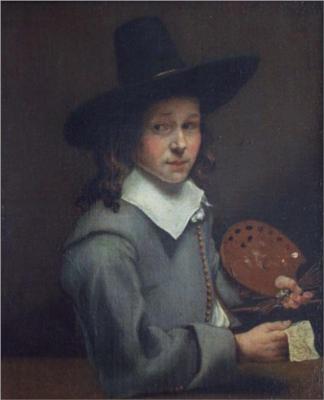
| Name | Aelbert Jacobsz Cuyp |
| Place of birth | Dordrecht, Netherlands |
| Date of Birth | October 20,1620 |
| Date of Death | November 15, 1691 |
| Field | Painting |
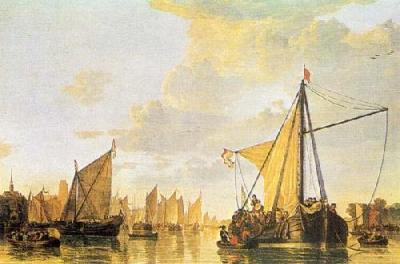
| Popular Works | The Maas at Dordrecht, The Negro Page circa |
CAREER:
In 1635, Cuyp moved to Amsterdam to study with the landscape painter Esaias van de Velde. After a few years of study, Cuyp began to paint landscapes and developed a style based on the work of van de Velde. He soon became a successful painter and was able to support himself with his art.
In 1644, Cuyp married his cousin, Marritgen Willems van Zijl. This marriage made him a member of the wealthy Zijll family, who were prominent citizens in Dordrecht. Cuyp's family connections enabled him to become a member of the Dordrecht Guild of St. Luke in 1646. Cuyp's paintings began to gain popularity, and he was soon able to paint full-time.
In the 1650s, Cuyp painted many landscapes in the Dutch countryside, often depicting scenes of everyday life. He also painted portraits of his family and friends. By the 1660s, Cuyp was becoming increasingly successful, and he was accepted into the prestigious Haarlem Guild of St. Luke in 1662.
Cuyp's landscapes continued to gain popularity throughout the 1660s, and he was able to produce more paintings. During this time, he was able to travel around the Netherlands and Europe, painting landscapes and portraits. He also became a successful art dealer, selling his paintings to wealthy patrons.
Cuyp's landscapes became more romantic and atmospheric during the 1670s and 1680s. He incorporated more elements of nature into his paintings, such as clouds, storms, and sunsets. His landscapes also featured more figures, often representing religious or mythological scenes.
Cuyp's popularity continued to grow throughout his life, and he was elected to the Amsterdam Painter's Guild in 1679. He was also appointed court painter to the court of William III of Orange. Cuyp's paintings were highly sought after and he was able to live comfortably from his art.
Cuyp died in 1691, leaving behind a legacy of beautiful landscape paintings. His art influenced many later landscape painters, such as Jacob van Ruisdael and Jan van Goyen. Cuyp's work is still highly regarded today, and his paintings can be found in many museums around the world.
WORKS OF AELBERT JACOBSZ CUYP: