Oil Painting » List of Painters » Akseli Gallen Kallela
EARLY DAYS:
Akseli Gallen-Kallela was a Finnish painter best known for his illustrations of the Kalevala, a collection of Finnish folk tales. He was born in 1865 in Finland, a small country in Northern Europe. His father, Carl, was a military chaplain and his mother, Sofia, was a homemaker. As a child, Akseli was inspired by the Finnish landscape, and he began to paint and draw at an early age.
Gallen-Kallela studied art in Helsinki and Paris, where he was exposed to the work of the French Impressionists. He was particularly inspired by the works of Paul Gauguin and Henri Rousseau. He was also exposed to the works of the Symbolists, and the influence of these two movements can be seen in much of his work.
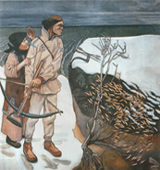
Gallen-Kallela was a strong advocate for Finnish art and culture and used his art to promote the unique identity of his homeland. His most famous works are his illustrations of the Kalevala, a collection of Finnish folk tales. He was able to capture the beauty of the Finnish landscape and its people in his works.
Gallen-Kallela's art was also heavily influenced by his religious beliefs. He was a devout Lutheran, and his works incorporated many religious themes. He also used his art to depict the struggles of the Finnish people and their fight for independence.
Gallen-Kallela was a prolific artist, producing hundreds of paintings and drawings throughout his life. He was also an active member of the Finnish artistic community, and he was a founding member of the Finnish Artists' Association.
Gallen-Kallela's art was highly influential in Finland, and he is considered to be one of the most important figures in Finnish art. His works are still widely appreciated today, and his influence can be seen in the works of many modern Finnish artists.
The legacy of Akseli Gallen-Kallela lives on in Finland. His works are displayed in museums and galleries throughout the country, and he is remembered as an important figure in the history of Finnish art. He is also remembered for his promotion of Finnish culture and his commitment to preserving the unique identity of his homelan..

Personal Details
| Name | Akseli Gallen Kallela |
| Place of birth | Pori, Finland |
| Date of Birth | April 26,1865 |
| Date of Death | March 7,1931 |
| Nationality | Finnish |
| Field | Painting |
| Movement | Romantic nationalism, Realism |
CAREER:
Gallen-Kallela's career began in earnest in the 1890s. In 1891, he traveled to Paris, where he studied painting with Fernand Cormon and Jean-Paul Laurens. He also traveled to Italy and Spain, where he was inspired by the works of El Greco and Francisco Goya. During his travels, he also developed a deep admiration for Norse mythology and Finnish folklore.
In 1895, Gallen-Kallela returned to Finland and began to paint some of his most iconic works, including the frescoes of the Kalevala in the Ateneum in Helsinki. His depictions of the Kalevala, the traditional Finnish epic, are some of the most influential works in Finnish art history. He also painted landscapes and views of his native Finland, as well as portraits of prominent figures such as J.V. Snellman, the famous Finnish statesman.
In 1906, Gallen-Kallela built a home and studio in the Finnish countryside, which he called the "Kallosaari". Here, he continued to work on his art, often in collaboration with his son, Jorma. He also built a printing press and created a series of woodcuts depicting the Kalevala.
Throughout his career, Gallen-Kallela was a vocal advocate for the promotion of Finnish art and culture. He was an active participant in the First Finnish Art Exhibition in 1897 and the Second Finnish Art Exhibition in 1899. He was also a founding member of the Finnish Art Association and the Finnish Artists' Association.
Gallen-Kallela's career was cut tragically short when he died suddenly in 1931. However, his legacy lives on in his works, which continue to be widely admired and appreciated in Finland and around the world. His art was a major influence on the development of the national romantic movement in Finland and his depictions of the Kalevala have become iconic. He is remembered as one of the most important figures in Finnish art history.
WORKS OF AKSELI GALLEN KALLELA: