Oil Painting » List of Painters » Alexandre Benois
EARLY DAYS:
Alexandre Nikolayevich
Benois was a prominent Russian artist, art critic, and art historian active in the late 19th and early 20th centuries. He was a major figure in the development of Russian art and was instrumental in helping to define the art of the Silver Age, a period during which Russian culture flourished.
Benois was born in Petersburg in 1870 to a family of aristocratic Russian origin. His father was a diplomat, and his mother was a talented artist who recognized his budding talent in the arts. He studied at the Imperial Academy of Arts in St. Petersburg, and started off as an illustrator for magazines and books. His illustrations for books like "Fairy Tale" and "The Bronze Horseman" earned him recognition as a talented artist.
Benois was an early member of the Mir iskusstva (World of Art) movement, which was founded in 1898. This movement aimed to create a new and modern aesthetic in the arts. Benois was a part of the group and was part of the publication of the journal Mir iskusstva, which was distributed all over Russia. This journal was a major influence on the development of the Silver Age art movement in Russia.
Benois was also a founding member of the Russian Ballet, along with Serge Diaghilev and Leon Bakst. This ballet was the first of its kind in Russia and was a major influence on the development of the Ballets Russes, a ballet company that was active in the early 20th century. Benois was responsible for coming up with the sets and costumes for some of the most iconic ballets of the time, including "The Sleeping Beauty", "Scheherazade", and "The Firebird".
In addition to his work in the arts, Benois was also a writer and art critic. He wrote for various Russian publications, including "The Spectator" and "The Russian Word". He also wrote a number of books on the history of Russian art and culture, such as "The History of Russian Art" and "Our Art".
Benois was a major influence on the development of Russian art, particularly in the Silver Age. His work in the arts and his writings helped to shape the culture of the time and were a major influence on the development of the Ballets Russes. He is remembered today as one of the most influential figures in the history of Russian art.
Personal Details
| Name | Alexandre Benois |
| Place of birth | Russia |
| Date of Birth | May 3, 1870 |
| Date of Death | Feb 9, 1960 |
| Nationality | Russian |
| Field | Painting |
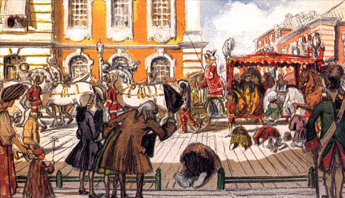
| Popular Paintings | Soldiers of Catherine II,Last Promenades of Louis XIV,Promenade of Empress Elizabeth through the Noble Streets of St. Petersburg |
CAREER:
Alexandre Benois studied at the Imperial Academy of Arts in St. Petersburg and graduated in 1892. During this time, he became friends with a group of avant-garde artists and writers, known as the "Jack of Diamonds", who would become an important part of his life.
After graduating, he worked as a set designer for various theaters in St. Petersburg and Moscow, including the Mariinsky and the Bolshoi. His work was praised for its bold and modern style, which was greatly influenced by his studies of French and Italian art. He also designed costumes and masks for the Ballets Russes, a ballet company founded by Sergei Diaghilev.
In 1907, he co-founded the Mir Iskusstva (World of Art) art movement. This movement focused on creating a new style of art that combined traditional Russian styles with the modern techniques of European art. He wrote extensively about art and design, and served as an editor for the movement's magazine.
Throughout his career, he was an important figure in the promotion of Russian art and culture. He wrote and published several books, including "The Art of the Theatre" and "The History of Russian Painting", and he was a member of the Imperial Academy of Arts. He also taught at the St. Petersburg Academy of Arts and was a professor of painting at the Moscow Institute of Art.
In the 1920s and 1930s, he moved to France and was a part of the Russian ?migr? community there. He continued to be active in the art world, writing and lecturing on art history and aesthetics. He was also a prolific painter, and his works were exhibited in galleries around the world.
Alexandre Benois died in Paris in 1960. His legacy lives on in the form of his writings, artwork, and influence on the Russian art world. His work was an important part of the development of Russian visual arts during the early 20th century, and his impact is still felt today.
WORKS OF ALEXANDE BENOIS: