Oil Painting » List of Painters » Andre Derain
Early Days:
Andre was born in Quincy, MA. He completed primary and secondary schooling in the Quincy public school system and studied art at Phillips Academy in Andover, MA from 1951 to 1953. While at Phillips Academy he became friends with Hollis Frampton who would later influence Andre's radical approach to sculpture through their conversations about art and through introductions to other artists.
Andre Derain (1880-1954) was a French painter and one of the leading figures of the Fauvism movement, a style known for its bold, vibrant use of color and emotional intensity. Born in Paris, Derain was initially trained as an engineer, but he later turned to art and studied at the *Academie Carriere* and then at the *Ecole des Beaux-Arts* in Paris, where he met fellow artist Henri Matisse, with whom he would later form a close artistic relationship.
Derain's early work was influenced by the Post-Impressionist style, particularly the works of Vincent van Gogh and Paul Gauguin, but he soon developed his own distinctive approach that set him apart. Fauvism, the movement he became most associated with, was characterized by the expressive use of color, where artists used bright, non-naturalistic hues to convey emotion rather than to represent reality. In 1905, at the Salon d'Automne in Paris, Derain exhibited his work alongside Matisse and other artists, and the critics were both shocked and captivated by their vibrant, unrestrained color choices. This exhibition marked the birth of Fauvism, and Derain became one of its key pioneers.
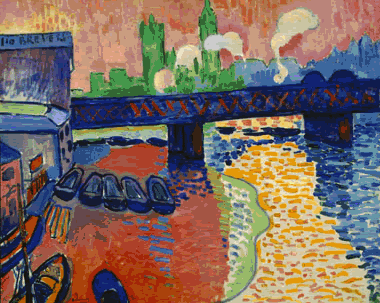
One of Derain's most famous works from this period is *The Charing Cross Bridge*, painted in 1906. It is a dynamic depiction of London's iconic bridge, rendered in bold, unnatural colors. The brushstrokes are expressive and free, and the colors create an emotional atmosphere, rather than simply depicting the scene in a realistic way. This piece exemplifies the Fauvist approach of using color for emotional impact rather than for accurate representation.
However, Derain's style evolved over time. After the initial explosion of Fauvist energy, he moved toward a more subdued, classicism-influenced style. His work from the 1910s and 1920s reflects a return to a more restrained use of color and a focus on structure and order. This shift was influenced by his interest in the art of ancient Greece and Italy, as well as his exposure to the work of the Old Masters, particularly those of the Renaissance. His later works feature more subdued palettes and a return to traditional techniques of drawing and composition, which contrasted sharply with his earlier, more experimental style.
In addition to his paintings, Derain was also known for his work in other mediums, including sculpture and graphic design. He collaborated with the French poet and playwright Jean Cocteau, designing sets and costumes for theater productions. Derain's ability to move between different artistic forms further attests to his versatility and broad influence on the art world.
Though Derain's association with Fauvism was brief, his contribution to the movement was crucial in establishing its impact on the development of modern art. His later shift toward classicism and his engagement with other artistic traditions reflected his constantly evolving approach to painting and his ability to adapt to changing artistic trends.
Throughout his life, Derain remained a respected figure in the French art world. His legacy is one of bold experimentation and a deep engagement with the traditions of Western art, bridging the gap between modernist innovation and classical techniques. Today, his works can be found in major collections around the world, and he is recognized as one of the significant figures in the early 20th-century avant-garde movement.
Personal Details
| Name | Andre Derain |
| Place of birth | France |
| Date of Birth | June 10, 1880 |
| Date of Death | September 8, 1954 |
| Nationality | French |
| Field | Painting,Sculpture |
| Popular Paintings | Charing Cross Bridge, London |
| Movement | Fauvism |
Career:
In 1965 he had his first public exhibition of work in the "Shape and Structure" show curated by Henry Geldzahler at the Tibor de Nagy Gallery.
Andre's controversial "Lever" was included in the seminal 1966 show at the Jewish Museum in New York entitled Primary Structures.
In 1969 Andre helped organize the Art Workers Coalition.
In 1970 he had a one man exhibition at the Solomon R. Guggenheim Museum, and has had one man exhibitions and participated in group shows in major museums, galleries, and kunsthalles throughout America and Europe.
Works of Andre Derain: