| |
Andrew Wyeth
Andrew Newell Wyeth (born July 12, 1917) is an
American realist painter, one of the best-known of the 20th century.
He is sometimes referred to as the "Painter of the People"
due to his popularity with the American public. Wyeth's favorite
subject is the land and inhabitants around his hometown of Chadds
Ford, Pennsylvania, and those near his summer home in Cushing, Maine.
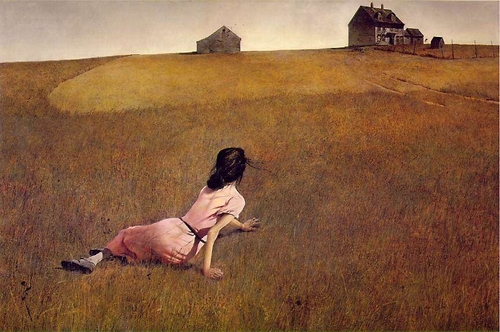
His most famous work, and one of the most well-known images in 20th
century American art, is Christina's World (1948), in the collection
of the Museum of Modern Art in New York City.
Childhood/Early Career
Andrew Wyeth is the son of Newell Convers Wyeth, a famous American
illustrator and artist. The youngest of five children, Andrew Wyeth
was home-tutored and learned art from his father. In 1937 at age
twenty, Wyeth had his first one-man exhibition of watercolors at
Macbeth Gallery in New York City. The entire inventory of paintings
quickly sold out, and Wyeth's career was launched.
In 1940 Wyeth married Betsy Merle James, whom he had met the year
before in Maine. Betsy introduced Wyeth to Christina Olson, who
later became the subject of the painting Christina's World. Christina,
her brother Alvaro and their weatherbeaten house became an important
subject of Wyeth's art for over twenty years. Betsy James Wyeth
has played a guiding and supportive role in Wyeth's art through
his career.
Father's Death / 1940s
In 1945 Andrew Wyeth's father, illustrator N.C. Wyeth, and his three-year-old
nephew were killed when their car stalled on railroad tracks near
their home and was struck by a train. Wyeth has referred to his
father's death as a formative emotional event in his artistic career,
in addition to a personal tragedy. It was shortly after this time
that Wyeth's art consolidated into his mature and enduring style,
characterized by a subdued color palette, highly realistic renderings,
and the depiction of emotionally-charged symbolic objects.
In 1948 Wyeth began painting Anna and Karl Kuerner, neighbors of
the Wyeths in Chadds Ford. Like the Olsons in Maine, the Kuerners
and their farm became one of Wyeth's most important subjects for
nearly 30 years.
Mature Career
Dividing his time between Pennsylvania and Maine, Wyeth has maintained
a relatively consistent realist painting style for over fifty years.
He has tended to gravitate to several identifiable landscape subjects
and models, to which he would return repeatedly over a period of
decades. He typically creates dozens of studies on a subject in
pencil or loosely brushed watercolor before executing a finished
painting, either in watercolor, drybrush (a watercolor style in
which the water is squeezed from the brush), or egg tempera. His
works have fetched increasingly higher prices with his growing fame,
and today Wyeth's major works can sell for in excess of one million
dollars from private dealers and at auction.
Critical Reaction
Wyeth's art has long been controversial. As a representational artist,
Wyeth's paintings have sharply contrasted with the prevailing trend
of abstraction that gained currency in American art in the middle
of the 20th century. Museum exhibitibitions of Wyeth's work have
set attendance records, but many art critics have derided his paintings.
The most common criticisms are that Wyeth's art verges on illustration,
and that his predominantly rural subject matter is heavily weighted
with sentiment. Admirers of Wyeth's art believe that his paintings,
in addition to sometimes displaying overt beauty, contain strong
emotional currents, symbolic content and underlying abstraction.
Most observers of Wyeth's art agree that he is exceptionally skilled
at handling the mediums of watercolor and egg tempera (which uses
egg yolk as a medium). Except for early experimentations, Wyeth
has avoided using traditional oil paints.
The Helga Paintings
A particularly controversial episode in Wyeth's career surrounded
a body of work Wyeth painted of Helga Testorf, a model he met through
the Kuerner family in Chadds Ford. Wyeth began painting Helga in
1971 and for nearly fifteen years she was one of Wyeth's most important
models. Unlike his other subjects, however, Wyeth kept the vast
majority of his Helga works a secret from everyone, including his
wife Betsy. He revealed the Helga pictures to Betsy in 1985, and
arranged a sale of the paintings to Leonard Andrews, a private investor,
the following year. Andrews arranged a publicity blitz that attracted
major museums to exhibit the artwork. Enticed by the suggestion
of a secret love affair between Wyeth and Helga, national news media
featured the story of Wyeth's secret cache of art. Following the
museum exhibtions, Andrews sold the works to an anonymous Japanese
industrialist in 1990 reportedly for a substantial profit. Some
curators felt that their museums were used to enhance the value
of the art prior to the sale. Some art critics thought that Wyeth
and his wife had fabricated the entire story of the secret cache
of paintings. Others simply admired the art. After the paintings'
sale to the anonymous Japanese industrialist in 1990, the paintings
were frequently exhibited at museums in the U.S. and Japan. The
paintings were resold in early December, 2005 to an American buyer,
who may break the collection up for individual sale.
Museum Collections
Andrew Wyeth is in the collection of most major American museums,
including The Metropolitan Museum of Art, the Whitney Museum of
American Art and the Museum of Modern Art in New York City; and
the Smithsonian American Art Museum, the National Gallery of Art,
in the Arkansas Art Center in Little Rock and the White House, in
Washington, DC. Especially large collections of Wyeth's art are
in the Brandywine River Museum in Chadds Ford, Pennsylvania; the
Farnsworth Museum of Art in Rockland, Maine, and the Greenville
County Museum of Art in Greenville, South Carolina. A major retrospective
of Andrew Wyeth's work will be at the Philadelphia Museum of Art[1]
from March 29, 2006 - July 16, 2006.
Honors and Awards
Wyeth has been the recipient of numerous honorary degrees. In 1963,
Andrew Wyeth became the first painter to receive the Presidential
Medal of Freedom, which was conferred by President John F. Kennedy.
In 1977, he became the first American artist since John Singer Sargent
elected to the Académie des Beaux-Arts. In 1980, Wyeth became
the first living American artist to be elected to Britain's Royal
Academy. In 1987 Wyeth received a D.F.A. from Bates College. In
1990, he was awarded the Congressional Gold Medal of Honor by President
George H. W. Bush.
Trivia
Andrew Wyeth's brother, Nathaniel C. Wyeth, invented the plastic
soda pop bottle.
Wyeth was used as a humorous device by cartoonist Charles M. Schulz
in the comic strip Peanuts. The character Snoopy was a collector
of fine art and had a Wyeth on display at a housewarming party that
went "over big."
Andrew Wyeth's father is the renowned illustrator N.C. Wyeth, known
for his illustrations for Treasure Island and Robinson Crusoe.
The paintings are the excellent portrayal of the events and scenes
that we see around us. The painters are the best cameras of the
world. They reproduce many different types of pictures. They even
draw imaginary pictures that do not exist in this world. We tend
to use both thinned oil paints and dense oil paints. Masterpieces
can be dyed more than once, but each time it may be different from
the existing paintings.h
|
|
|
|
|
| |
| | | | | | | | | | |
|
|
|