| |
Brett Whiteley
Brett Whiteley (7 April 1939 - 15 June 1992) was
an Australian artist. One of the most well known Australian painters
of the 20th century, he is collected in most Australian galleries.
He had many shows in his career, and travelled extensively.
Career
Early years
Whiteley was born in Sydney, where he started drawing very early
in his life. While a teenager, he painted on weekends at Bathurst
and Sydney with such works as The Soup Kitchen which he did in 1958.
In 1960, Whiteley won a Travelling Scholarship from the Italian
Government, and moved to London. One of the works he submitted to
win the scholarship was done in images which were slightly abstracted
in brownish colours called Sofala; he had painted this in 1956.
After winning the scholarship he travelled around Europe, visiting
Italy, France and England. He arrived in London at a time when many
Australian artists were becoming popular in England. During this
period, there was a fascination with Australian art there. Australian
artists Arthur Boyd, Sidney Nolan and Russell Drysdale had become
well known and were exhibiting in London, as well as many other
Australian artists who were also there. It helped him that Australian
artists were looked on favourably at this time by the English public.
After meeting the director of the Whitechapel gallery, he was included
in the group show 'Survey of Recent Australian Painting' where his
Untitled Red painting was bought by the Tate gallery. This made
him the youngest artist to have ever been bought by the Tate, and
it was this fact which helped him to have even more success, such
as when he won the first prize for Australia at the Biennale de
la Jeunesse in Paris. During the next few years he had much contact
with artists in London and in travels to other parts of the world,
and it was these friendships and contacts which helped him to become
an accepted artist.
New York
In 1967 Whiteley won a scholarship to study and work in New York.
He won this Harkness Foundation Scholarship to New York, and while
there he met other artists and musicians while he stayed at the
Chelsea Hotel. His first impression of New York was shown in the
painting First Sensation of New York City which showed streets with
fast moving cars, street signs, hot dog vendors, and tall buildings.
He was very much influenced by the peace movement at the time and
came to believe that if he painted one huge painting which would
advocate peace, then the Americans would withdraw their troops from
Vietnam. It was an extremely ambitious aim, to change the opinion
of an entire nation based on one picture. But still fairly young,
Whiteley was idealistic and caught up in the great peace movements
of the sixties, with the protests against America's involvement
in the war in Vietnam. The work was called The American Dream, and
was an enormous work comprising many panels, and using painting
and collage and anything else he could find to put on the panels.
One way that America influenced him is the scale of the works. The
large size of artworks painted by contemporary America artists there
possibly made Whiteley wish to paint enormous works such as this
one. It took up a great deal of his time and effort to paint, taking
up about a year of working on it full time. It consisted of eighteen
wooden panels, with a series which started with a peaceful dreamlike
serene ocean scene on one side, that worked its way to destruction
and chaos in a mass of lighting, red colours and explosions on the
other side. It was his comment on the direction the world would
be headed and his response to a seemingly pointless war which could
end in a nuclear holocaust. Many of the ideas from the work may
have come from his experiences with alcohol, marijuana and other
drugs. During this time, like many others, Whiteley experimented
with drugs. He believes that many of his ideas have come from these
experiences, and he often used drugs as a way of bringing the ideas
from his subconscious. He sometimes took more than his body could
handle, and had to be admitted to hospital for alcohol poisoning
twice. Around him at the Chelsea Hotel, other artists and musicians
took heroin, which Whiteley did not take at that time. The painting
which was finally produced was made of many different elements,
using collage, photography and even flashing lights, with a total
length of nearly 22 metres. However Marlborough-Gerson, his gallery,
refused to show this work which he had been working on for about
a year, and he was so distraught that he decided to leave New York,
and he 'fled' to Fiji in the South Pacific, similar to how the last
panel of the end of The American Dream showed an island paradise,
Whiteley would now seek refuge in one himself.
Fiji
Whiteley made paintings in Fiji of the people, similar to the
way that Gauguin had travelled to Tahiti to paint native people
and culture in the nineteenth century. Whiteley painted the native
people of Fiji, such as in Fiji Head - to a creole lady which incorporates
text as well as a downward looking portrait. During his time in
Fiji, he started painting birds, which were a source of great beauty
for him which he enjoyed painting. The birds which he painted could
represent a way of escaping from sometimes violent feelings. He
had a violent nature that others noticed. Whiteley had experience
in painting animals from his zoo series in London. A stylised image
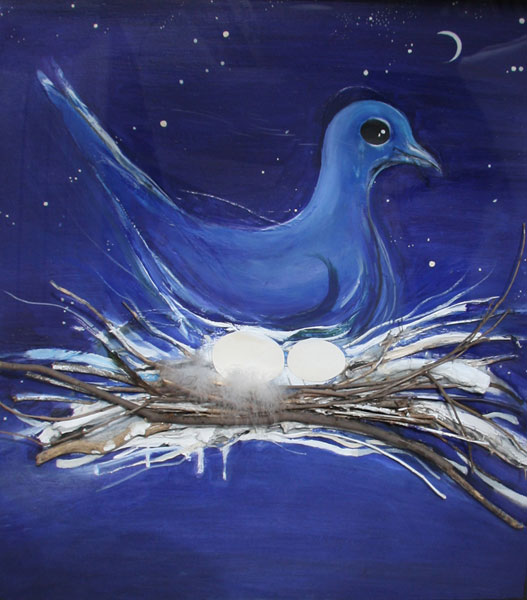
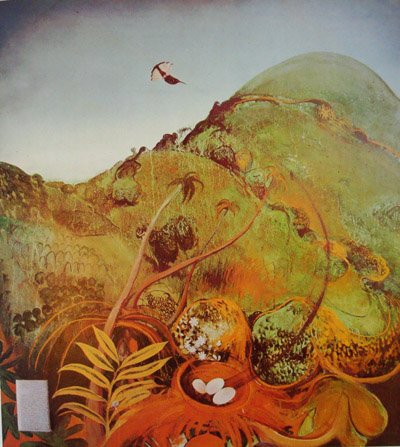
of a bird he painted in Orange Fruit Dove Fiji which shows the bird
looking towards fruit on a plant, while it is sitting on its nest
with eggs shown below. The bird is bright and striking, with red
which could represent blood shown on its body and on its beak. He
must have been thinking about Gauguin's experience in Tahiti, for
he painted Gauguin which showed an image of a daydreaming Gauguin
against a backdrop of island scenery. He later developed further
works based on the art of other artists. In the early 1970s he returned
to Australia, an established and collected artist.
Appropriations
Whiteley experimented with styles based around the art of Van
Gogh, using portraits based on Vincent Van Gogh's self portraits,
such as Vincent. After Whiteley found a book about Van Gogh on the
floor of the church in Bathurst when he was very young, it changed
his perception of the world around him. One image which uses Van
Gogh's style in a unique way is Night Cafe. He has taken the Van
Gogh painting and stretched the lines of the room to a single vanishing
point, creating an image which appears fast moving and extremely
vibrant and dynamic. Another work where imagery is borrowed from
the art of another artist is in Rembrandt, where he painted a large
somewhat gloomy looking portrait of the Dutch master.
Alchemy
Part of his work Alchemy was featured on the cover of the Dire
Straits live album Alchemy although it had the addition of a guitar
with lips held by a hand. The original painting, done between 1972
and 1973 was composed of many different elements and on many different
panels, similar to The American Dream. While the idea of the massive
work on many different panels had developed in America, this new
work was Australian. It had many curved and illustrious shapes,
sexual imagery and giant letters IT on one of the panels. Just looking
at the elements from which he composed the work shows the wide variety
in materials he used; everything from feathers and part of a birds
nest to a glass eye, shell, plugs and 'brain'. It has been regarded
as a self-portrait, a giant outpouring of energy and ideas brought
forth over a long period of time. He did not even know what it would
look like when it was finished. Many of the panels are golden, referring
to the process of alchemy. Others are full of tiny drawings and
little details showing forms, many of which are based on the human
figure, such as ears, hands, body parts and sexual imagery. The
work refers to transformation, such as with the mythical transformation
of ordinary metal to gold, Whiteley is possibly trying to say something
about his personality, that he wanted to change away from various
addictions, but was not able to. He is also talking about looking
at what does not exist.
Sydney harbour and landscapes
Whiteley loved painting Sydney Harbour views in the 1970s such
in his painting Interior with time past, which shows an interior
and exterior view starting with a room that leads through open windows
to the harbour full of boats outside. The table in the front of
the room close to the viewer has minutely decorated vases and small
objects, while a drawing on the left and a sculpture to the extreme
right show how Whiteley often used erotic images in his works. He
painted a view of his friend Patrick White as a rock or a headland
in Headland, because he had told Whiteley that in the next life
he would like to come back as a rock. Whiteley painted other images
of the Australian landscape, including a view of the south coast
of New South Wales after it had been raining called South Coast
After the Rain. He did paintings of the area around Bathurst, Oberon
and also Marulan, all in New South Wales. He painted abstracted
images of bush scenes such as The Bush and also images which resulted
from experimentation with various drugs, such as alcohol in the
humorous Self Portrait after three bottles of wine.
Success with Archibald and other prizes
In the late seventies Brett Whiteley had great success with the
Art Gallery of New South Wales, winning all of their major prizes
twice. These were the Archibald Prize, Wynne Prize and Sulman Prizes,
considered some of the most prestigious, if not the most prestigious
art prizes in Australia.
His wins were:
1976
1. Archibald Prize: Self Portrait in the Studio
2. Sulman Prize: Interior with Time Past
1977
Wynne Prize: The Jacaranda Tree (On Sydney Harbour)
1978
1. Archibald Prize: Art, Life and the other thing
2. Sulman Prize: Yellow Nude
3. Wynne Prize: Summer at Carcoar
1978 was the only time that all three prizes have gone to the
same person, so this was quite an achievement. He was at the peak
of his career. His first Archibald win, Self Portrait in the Studio
shows a view of his studio at Lavender Bay overlooking the harbour,
with his reflection in a mirror shown at the bottom of the picture,
while the painting is primarily a look at his studio, shown in
deep, bluish tones. As with many of his works, the viewer is led
deeper into the picture with minute detail, and a view of Sydney
harbour is on the left which establishes the location of the picture.
These paintings along with some of the other works, show Whiteley's
love for ultramarine blue and for collecting objects and for wide
expanse of harbour. His second Archibald win, Art, Life and the
other thing, again shows his willingness to experiment with different
mediums such as photography and collage, and his respect for art
history, including an image of the famous 1943 William Dobell
portrait of Joshua Smith, which won a court case against people
who claimed it was a caricature, not a portrait. He also experiments
with warping and manipulating a straight self portrait and altering
and distorting the image. He later won the Wynne Prize again,
in 1984 with The South Coast After Rain
Difficult pleasure
He was the subject of a hour long ABC television documentary
called Difficult Pleasure directed by Don Featherstone in 1989,
which showed him talking about many of his main works, and his
recent works such as ones done on a month long trip to Paris,
one of his last overseas trips. He also showed his large T-shirt
collection, and talks about his sculpture, which he said is an
aspect that many people do not take seriously about his work.
Difficult pleasure is how he describes painting, or creating art:
Art is an argument between what a thing looks like and what it
means.
Later years
Whiteley became increasingly dependent on alcohol and became
addicted to heroin leading to bouts of schizophrenia.Whiteley's
work output began a steep decline, although its market value continued
to climb. He made several attempts to dry out and get off drugs
completely, all ultimately unsuccessful. In 1989, he divorced
Wendy, whom he had always credited as his 'muse', and on June
15, 1992 he died of a heroin overdose alone in a motel in Thirroul,
north of Wollongong, New South Wales.
In 1999 Brett Whiteley's painting The Jacaranda Tree (1977) which
had won the Wynne Prize, sold for $1,982,000, a record for a modern
Australian painter. Before this, his previous highest selling
work was The Pond at Bundanon for $649,500
The paintings are the excellent portrayal of the events and scenes
that we see around us. The painters are the best cameras of the
world. They reproduce many different types of pictures. They even
draw imaginary pictures that do not exist in this world. We tend
to use both thinned oil paints and dense oil paints. Masterpieces
can be dyed more than once, but each time it may be different from
the existing paintings.h
|
|
|
|
|
| |
| | | | | | | | | | | | |
|
|
|