|
Bridget Riley
Bridget Louise Riley CH CBE (born April 24, 1931
in London) is a British painter, one of the foremost proponents
of op art, art exploiting the fallibility of the human eye.
Riley was born in London and educated at Cheltenham Ladies' College
and studied art first at Goldsmiths College and later at the Royal
College of Art, with fellow students including Peter Blake and Frank
Auerbach. She left college early to look after her sick father,
and suffered a mental breakdown shortly thereafter. After recovery
she took on a number of jobs, including several as an art teacher
and for a time worked in the art department of the advertising company
John Walter Thompson.
Towards the end of the 1950s, Riley began to produce works in a
style recognisably her own. This style came from a number of sources.
A study of the pointillism of Georges Seurat, and subsequent landscapes
produced in that style, led to an interest in optical effects. The
paintings of Victor Vasarely, who had used designs of black and
white lines since the 1930s, are an obvious influence. Particularly
in later works, the influence of futurists, especially Giacomo Balla,
can also be discerned.
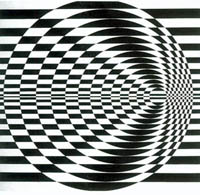
Around the end of the 1950s, Riley began to paint the black and
white works for which she is probably best known today. They present
straight or wavy lines (occasionally discs or squares instead),
which give the illusion of movement or colour. Works in this style
made up her first solo show in London in 1962 at Gallery One run
by Victor Musgrave.
Although mainly remembered today for the impressions of movement
and colour they give through the exploitation of optical illusions,
it is said that the impetus for Riley making these apparently cold
and calculated works was a failed love affair. One of the more famous
works in this style is Fall (1963).
Riley exhibited in the 1965 New York City show, The Responsive
Eye, the exhibition which first drew attention to so-called op art.
One of her paintings was reproduced on the cover of the show's catalogue,
though Riley later became disillusioned with the movement, and expressed
regret that her work was exploited for commercial purposes.
By the end of the 1960s, Riley was using a full range of colour.
Apparently she started using colour after a trip to Egypt, where
she was inspired by the colourful hieroglyphic decoration. Sometimes
lines of colour are used to give a shimmering effect, while other
works fill the canvas with tessellating patterns. In many works
since this period, Riley has employed others to do the painting,
while she concentrates on the actual design of her work.
The paintings are the excellent portrayal of the events and scenes
that we see around us. The painters are the best cameras of the
world. They reproduce many different types of pictures. They even
draw imaginary pictures that do not exist in this world. We tend
to use both thinned oil paints and dense oil paints. Masterpieces
can be dyed more than once, but each time it may be different from
the existing paintings.h
|
|
|
|
|
| |
| | | | | | | | | | | | |
|