|
Canaletto
Giovanni Antonio Canal (October 7, 1697 –
April 19, 1768), better known as Canaletto, was a Venetian artist
famous for his landscapes or vedute of Venice. They served as the
equivalent of painted postcards for those able to afford the price.
He was a son of a painter Bernardo Canal, hence his nickname Canaletto
He served his apprenticeship with his father and
his brother, and began his career as a theatrical scene painter,
which was his father's occupation. Canaletto was inspired by the
Roman vedutista Giovanni Paolo Pannini and began painting in his
famous topographical style after a visit to Rome in 1719. His first
known signed and dated work is Architectural Capriccio (1723, Milan,
in a private collection). One of his best pieces is The Stonemason's
Yard (1729, London, the National Gallery) which depicts a humble,
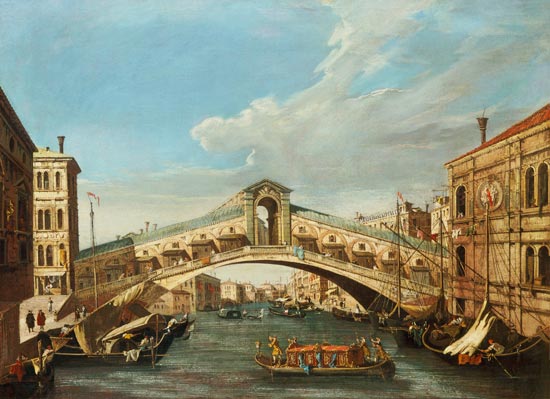
working area of the city. Canaletto, however, is better known for
his grand scenes of the canals of Venice and the Doge's Palace.
Many of Canaletto's early works, contrary to the
custom of the time, were painted 'from nature' (rather than from
sketches and studies of the scene taken back to be worked on in
the artist's studio). Some of his later works do revert to this
custom, hinted at by the tendency for distant figures to be painted
as blobs of colour - an effect produced by using a camera obscura,
which blurs farther-away objects.
Many of his pictures were sold to Englishmen on
their Grand Tour, most notably the merchant Joseph Smith (who was
later appointed British Consul in Venice in 1744). It was Smith
who acted as an agent for Canaletto, helping him to sell his paintings
to other Englishmen. In the 1740s Canaletto's market was disrupted
when the War of the Austrian Succession led to a reduction in the
number of British visitors to Venice. Smith also arranged for the
publication of a series of etchings of capriccios, but the returns
were not high enough, and in 1746 Canaletto moved to London, to
be closer to his market.
He remained in England until 1755, producing views
of London and of his patrons castles and houses. Overall this period
was not satisfactory, partly due to disatisfaction with the declining
quality of Canaletto's work. Canaletto's work began to suffer from
repetitiveness, losing its traditional fluidity, and became mechanical
to the point that the English art critic George Vertue suggested
that the man painting under the name 'Canaletto' was an imposter.
Canaletto gave public demostrations of his work to refute this claim;
however, his reputation never fully recovered in his lifetime.
After his return to Venice Canaletto was elected
to the Venetian Academy in 1763. He continued to paint until his
death in 1768. In his later years he often worked from old sketches,
but he sometimes produced surprising new compostions. He was willing
to make subtle alternation to topography for artistic effect.
Joseph Smith sold much of his collection to George
III, creating the bulk of the large collection of Canalettos owned
by the Royal Collection. There are many examples of his work in
other British collections, including several at the Wallace Collection
and a set of 24 in the dining room at Woburn Abbey. The record price
paid at auction for a Canaletto is £18.6 million for View
of the Grand Canal from Palazzo Balbi to the Rialto, set at Sotheby's
in London in July 2005. The picture was purchased by an unnamed
collector.
The paintings are the excellent portrayal of the events and scenes
that we see around us. The painters are the best cameras of the
world. They reproduce many different types of pictures. They even
draw imaginary pictures that do not exist in this world. We tend
to use both thinned oil paints and dense oil paints. Masterpieces
can be dyed more than once, but each time it may be different from
the existing paintings.h
|
|
|
|
|
| |
| | | | | | | | | | | | |
|