|
Carl Andre
Carl Andre (born September 16, 1935) is an American
minimalist artist.
Andre was born in Quincy, Massachusetts, and after
studying art in the States and in Europe became an intelligence
officer with the United States Army in North Carolina. In 1957 he
moved to New York City to work as an editor, and in the early 1960s
worked as a railroad conductor on the Pennsylvania Railroad. His
first solo show came in 1965.
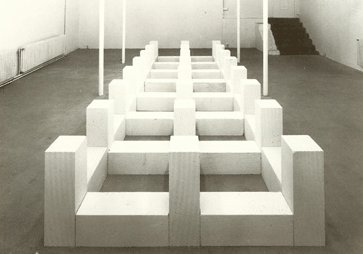
Andre's work has been typified by the use of natural
or simple commercially available materials, such as bricks, metal
plates or concrete blocks, stacked or arranged side by side in simple
patterns. One of his first distinctive works is Cedar Piece, which
consists of pieces of wood stacked on top of one another in a tall
column. Andre cited the wooden sculptures of Constantin Brancusi
as an influence in this and similar works.
A little later in the 1960s, Andre began to make
so-called "scatter pieces", which consisted of pieces
of a particular material arranged, apparently at random, on the
floor. Later came pieces such as 10 x 10 Altstadt Copper Square
(1967), a ten by ten arrangement of 100 copper tiles on the floor.
Andre has made a number of similar pieces, sometimes using just
one kind of metal, sometimes using two and arranging them in a chessboard
pattern. The viewer is free to walk over these pieces, if they so
choose.
Andre made a series of works called Equivalents,
all of them arrangements of 120 identical bricks in simple patterns.
In 1972 the Tate Gallery in London bought his Equivalent VIII (1966),
which four years later was the subject of an outcry from parts of
the media, who accused them of wasting public money.
Since the earliest time in his career, Andre has
also produced concrete poetry. Many have seen the arrangement of
words on the page in these poems as reflecting the arrangement of
units on the floor in his sculptures.
Andre was married to the Performance Artist Ana
Mendieta until her death in 1985. Andre claimed her death was suicide
but he was tried, and acquitted, for murder.
The paintings are the excellent portrayal of the events and scenes
that we see around us. The painters are the best cameras of the
world. They reproduce many different types of pictures. They even
draw imaginary pictures that do not exist in this world. We tend
to use both thinned oil paints and dense oil paints. Masterpieces
can be dyed more than once, but each time it may be different from
the existing paintings.h
|
|
|
|
|
| |
| | | | | | | | | | | | |
|