| |
Charles Le Brun
Charles Le Brun (February 24, 1619 - February
22, 1690) was a French painter and art theorist, one of the dominant
artists in 17th century France.
Born in Paris, he attracted the notice of Chancellor
Séguier, who placed him at the age of eleven in the studio
of Simon Vouet. He was also a pupil of François Perrier.
At fifteen he received commissions from Cardinal Richelieu, in the
execution of which he displayed an ability which obtained the generous
commendations of Nicolas Poussin, in whose company Le Brun started
for Rome in 1642.
In Rome he remained four years in the receipt of
a pension due to the liberality of the chancellor. There he worked
under Nicolas Poussin, adapting the latter's theories of art.
On his return to Paris in 1646, Le Brun found numerous
patrons, of whom Superintendent Fouquet was the most important.
Employed at Vaux-le-Vicomte, Le Brun ingratiated himself with Mazarin,
then secretly pitting Colbert against Fouquet. Colbert also promptly
recognized Le Brun's powers of organization, and attached him to
his interests. Together they founded the Academy of Painting and
Sculpture (Académie royale de peinture et de sculpture, 1648),
and the Academy of France at Rome (1666), and gave a new development
to the industrial arts.
In 1660 they established the Gobelins, which at
first was a great school for the manufacture, not of tapestries
only, but of every class of furniture required in the royal palaces.
Commanding the industrial arts through the Gobelins - of which he
was director - and the whole artist world through the Academy -
in which he successively held every post - Le Brun imprinted his
own character on all that was produced in France during his lifetime,
and gave a direction to the national tendencies which endured after
his death.
The nature of his emphatic and pompous talent was
in harmony with the taste of the king, who, full of admiration at
the decorations designed by Le Brun for his triumphal entry into
Paris (1660), commissioned him to execute a series of subjects from
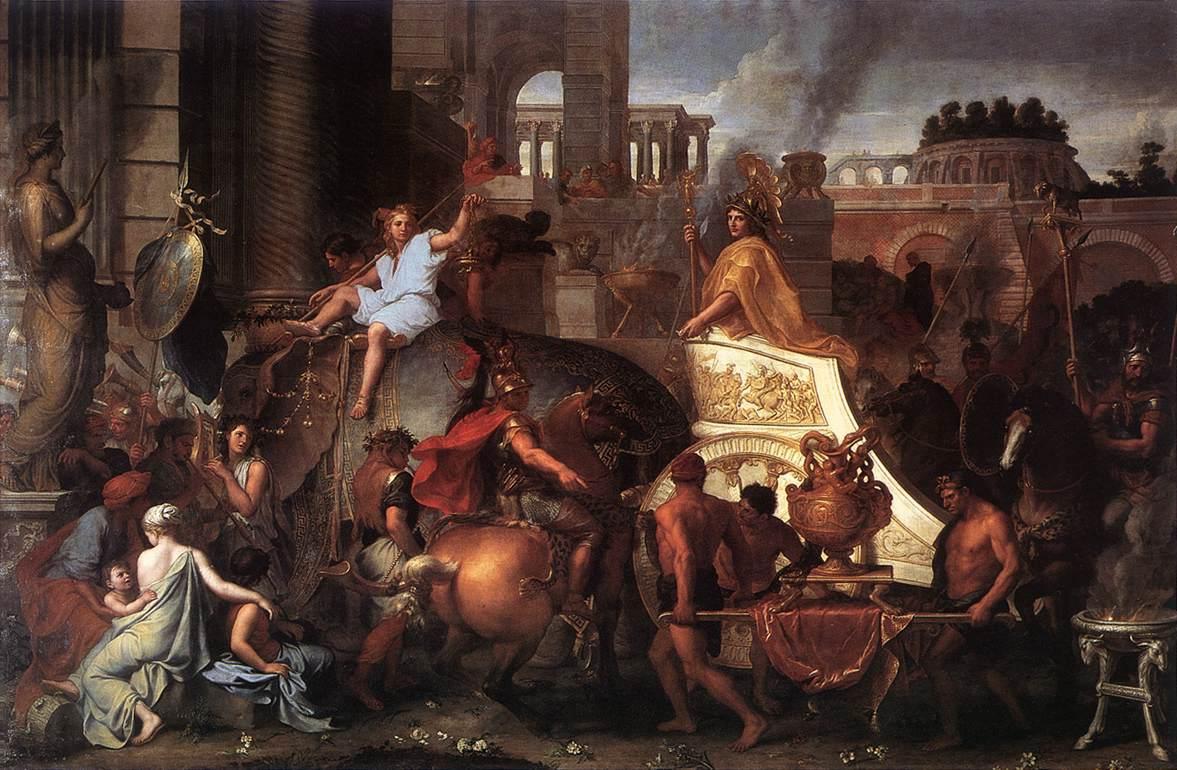
the history of Alexander. The first of these, "Alexander and
the Family of Darius," so delighted Louis XIV that he at once
ennobled Le Brun (December, 1662), who was also created Premier
Peintre du Roi (First Painter to His Majesty) with a pension of
12,000 livres, the same amount as he had yearly received in the
service of the magnificent Fouquet.
From this date all that was done in the royal palaces
was directed by Le Brun. In 1663, he became director of the Académie
royale de peinture et de sculpture, where he laid the basis of academicism
and became the virtual dictator of the arts in France.
Alexander and Porus, painted 1673The works of
the gallery of Apollo in the Louvre were interrupted in 1677 when
he accompanied the king to Flanders (on his return from Lille he
painted several compositions in the Chateau of St Germains), and
finally - for they remained unfinished at his death - by the vast
labours of Versailles, where he reserved for himself the Halls of
War and Peace (Salons de la Guerreand de la Paix, 1686), the Ambassadors'
Staircase, and the Great Gallery (Galerie des Glaces, 1679–1684),
other artists being forced to accept the position of his assistants.
At the death of Colbert, François-Michel
le Tellier, who succeeded him in the department of public works,
showed no favour to Le Brun, and in spite of the king's continued
support he felt a bitter change in his position. This contributed
to the illness which on February 22, 1690 ended in his death in
the Gobelins, in Paris.
Le Brun primarily worked for King Louis XIV, for
whom he executed large altarpieces and battle pieces. His most important
paintings are at Versailles. Besides his gigantic labours at Versailles
and the Louvre, the number of his works for religious corporations
and private patrons is enormous. Le Brun was also a fine portraitist
and an excellent draughtsman. He modelled and engraved with much
facility, and, in spite of the heaviness and poverty of drawing
and colour, his extraordinary activity and the vigour of his conceptions
justify his claim to fame. Nearly all his compositions have been
reproduced by celebrated engravers.
In his posthumously published treatise, Méthode
pour apprendre à dessiner les passions (1698) he promoted
the expression of the emotions in painting. It had much influence
on 18th-century art theory.
The paintings are the excellent portrayal of the events and scenes
that we see around us. The painters are the best cameras of the
world. They reproduce many different types of pictures. They even
draw imaginary pictures that do not exist in this world. We tend
to use both thinned oil paints and dense oil paints. Masterpieces
can be dyed more than once, but each time it may be different from
the existing paintings.h
|
|
|
|
|
| |
| | | | | | | | | | | | |
|
|
|