|
David Bomberg
David Bomberg (December 5, 1890 – August
19, 1957) was a painter, born in Birmingham, England.
Bomberg trained as a lithographer in Birmingham
and gained his artistic licence from the upbringing he received
in the ever changing Industrial landscape.
Bomberg later went on to study art in London, first
at the Westminster School of Art (where he was taught by Walter
Sickert), and later at the Slade School of Art.
He travelled to France where he met Modigliani
and Picasso.
Bomberg's first well known works date from the
1910s. They are rather complex geometric compositions built over
relatively traditional subjects, and typically use a limited number
of striking colours. Humans are turned into simple, angular shapes,
and a simple grid-work colouring scheme sometimes overlays the whole
painting. Mud Bath (1914) and In The Hold (probably 1914) can be
said to be typical of this period.
At this time, Bomberg was associated with Vorticism,
though he never allowed himself to be a full member of the movement,
despite Wyndham Lewis' efforts, not allowing his work to be reproduced
in BLAST, the Vorticists' journal, for example.
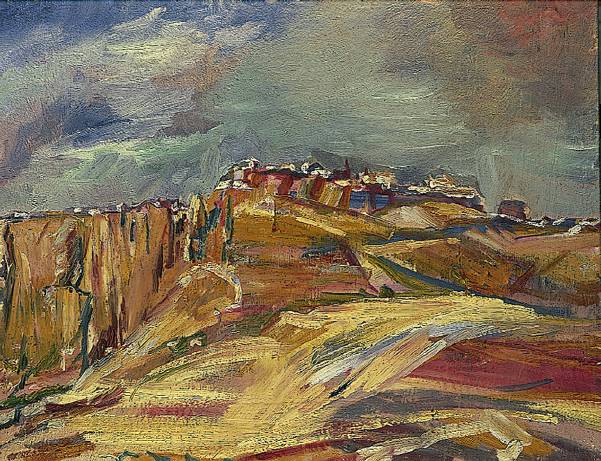
Later, Bomberg's works became more representational,
and from the late 1920s his style became more expressionist. He
painted a number of portraits and landscapes of the places he travelled
to in the Middle East and Europe.
Bomberg also worked as a teacher at the Borough
Polytechnic in London from 1945 to 1953, where he taught Frank Auerbach
and Leon Kossoff, among others.
Bomberg died in London in 1957, his critical stock
rising sharply thereafter. A major retrospective of his work was
held at the Tate Gallery in 1988.
The paintings are the excellent portrayal of the events and scenes
that we see around us. The painters are the best cameras of the
world. They reproduce many different types of pictures. They even
draw imaginary pictures that do not exist in this world. We tend
to use both thinned oil paints and dense oil paints. Masterpieces
can be dyed more than once, but each time it may be different from
the existing paintings.h
|
|
|
|
|
| |
| | | | | | | | | | | | |
|