Decollage, in art, is the opposite of collage instead of an image being built up of all or parts of existing images, it is created by cutting, tearing away or otherwise removing, pieces of an original image. Examples include inimage or etrecissements and excavations.
The French word "decollage" translates into English literally as "take-off" or "to become unstuck." The term is now commonly used in the French language in regard to aviation (as when an airplane lifts off the ground).
A similar technique is the lacerated poster, a poster in which one has been placed over another or others, and the top poster or posters have been ripped, revealing to a greater or lesser degree the poster or posters underneath. Although artist Mark Kostabi claims that "Mimmo Rotella invented the technique of using torn posters to make art in the early 1950s", examples of the genre done without any surrealist or artistic intent predate this, as do Raymond Hains'. The lacerated poster was an artistic intervention that sought to critique the newly emerged advertising technique of large-scale colour advertisements. In effect, the decollage destroys the advertisement, but leaves its remnants on view for the public to contemplate. The lacertaed poster became an artform as early as 1949.



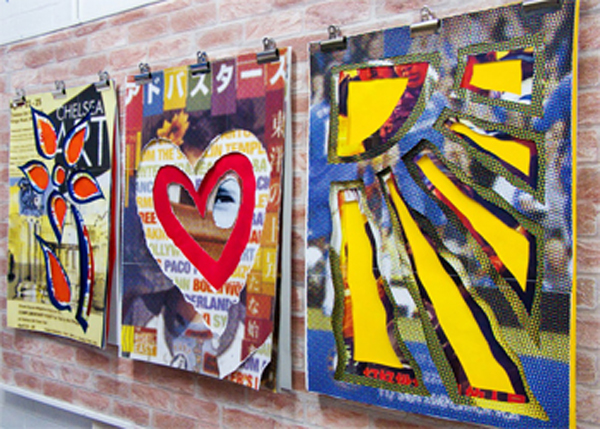
Lacerated posters are closely related to Richard Genovese's practice of "excavations."
The most celebrated artists of the decollage technique, especially of the lacerated poster, are Francois Dufrene, Jacques Villegle, Mimmo Rotella, and Raymond Hains. Often these artists worked collaboratively and it was thier intention to present their artworks in the city of Paris anonymously. These four artists were part of a larger group in the 1960s called Nouveau Realisme (New Realism), Paris answer to the American Pop movement. This was a mostly Paris-based group (which included Yves Klein and Christo, and was created with the help of critic Pierre Restany), although Rotella was Italian and moved back to Italy shortly after the group was formed. A contemporary artist employing similiar decollage techniques is Mark Bradford, who lives and works in Los Angeles.