Diego Velázquez

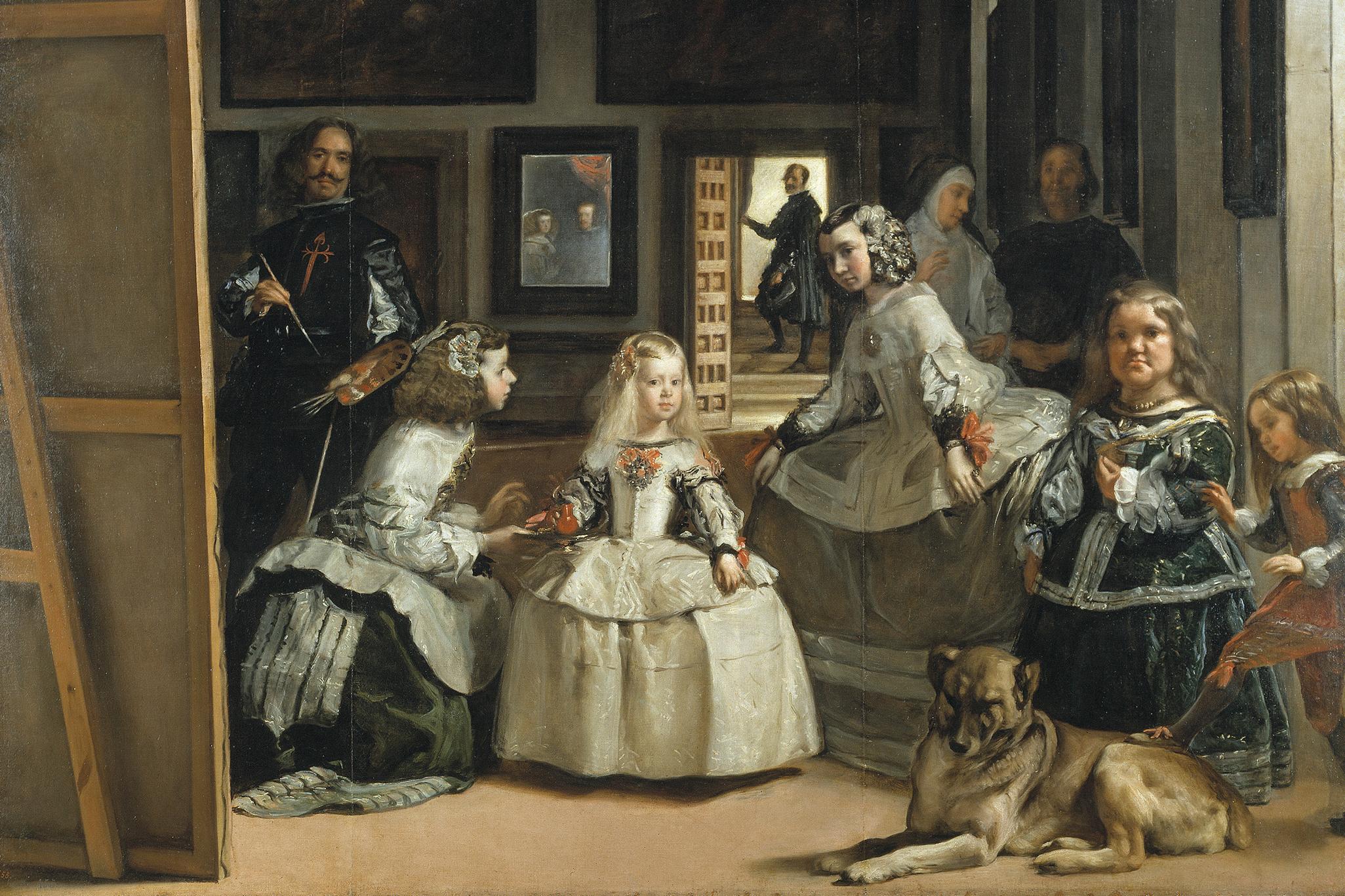
Diego Rodríguez de Silva y Velázquez (June, 1599 – August 6, 1660), commonly referred to as Diego Velázquez, was a Spanish painter, the leading artist in the court of King Philip IV. He was an individualistic artist of the contemporary baroque period, important as a portrait artist. His two visits to Italy while part of the Spanish court are well-documented. In addition to numerous renditions of scenes of historical and cultural significance, he created scores of portraits of the Spanish royal family, other notable European figures, and commoners, culminating in the production of his masterpiece, Las Meninas (1656).

Starting in the first quarter of the nineteenth century, Velázquez's artwork proved a model for the realist and impressionist painters, in particular Édouard Manet. Since that time, more modern artists, including Spain's Pablo Picasso and Salvador Dalí, have paid tribute to Velázquez by recreating several of his most famous works.


Early life
Velázquez, born in Seville, Andalusia early in June 1599 and baptized on June 6, was the son of Juan Rodríguez de Silva, a lawyer of noble Portuguese descent, and Jerónima Velázquez, a member of Seville's hidalgo class, an order of minor aristocracy (it was a Spanish custom, in order to maintain a legacy of maternal inheritance, for the eldest male to adopt the name of his mother). He was educated by his parents to fear God and, intended for a learned profession, received good training in languages and philosophy. But he showed an early gift for art; consequently, he began to study under Francisco de Herrera, a vigorous painter who disregarded the Italian influence of the early Seville school. Velázquez remained with him for one year. It was probably from Herrera that he learned to use brushes with long bristles.

After leaving Herrera's studio when he was 11 years old, Velázquez began to serve as an apprentice under the pedantic Francisco Pacheco, a founded artist and teacher in Seville. Though considered a generally dull, commonplace painter, at times Pacheco would express a simple, direct realism that is in contradiction to the style of Raphael that he was taught. Velázquez remained in Pacheco's school for five years, studying proportion and perspective and witnessing the trends in the literary and artistic circles of Seville.
 

The paintings are the excellent portrayal of the events and scenes that we see around us. The painters are the best cameras of the world. They reproduce many different types of pictures. They even draw imaginary pictures that do not exist in this world. We tend to use both thinned oil paints and dense oil paints. Masterpieces can be dyed more than once, but each time it may be different from the existing paintings.h

Sitemap
Painter sitemap
Techniques sitemap
Materials sitemap


famous paintings | famous painters | painting styles | famous artists | mixed media painting | painting technique | oil paintings | canvas painting | life oil painting still | abstract art paintings | modern art work | fine art painting landscape | oil painting reproductions - media | history of paintings | oil painting - idioms | links | review painting articles | review painting news | press release


