| |
Domenico Ghirlandaio
Domenico Ghirlandaio (1449 - January 11, 1494)
was a Florentine painter from the Renaissance and a contemporary
of Botticelli and Filippino Lippi, head of the large and prosperous
workshop. He studied with Baldovinetti and later taught Michelangelo.
Early life
His full name is given as Domenico di Tommaso Curradi
di Doffo Bigordi; it appears therefore that his father's surname
was Curradi, and his grandfather's Bigordi. The painter is generally
termed Domenico Bigordi, but some authors give him, and apparently
with reason, the paternal surname Curradi. Ghirlandajo (garland-maker)
was only a nickname, coming to Domenico from the employment of his
father (or else of his earliest instructor), who was renowned for
fashioning the metallic garlands worn by Florentine damsels; he
was not, however, as some have said, the inventor of them. Tommaso
was by vocation a jeweller on the Ponte Vecchio, or perhaps a broker.
Domenico, the eldest of eight children, was at
first apprenticed to a jeweller or goldsmith, probably enough his
own father; in his shop he was continually making portraits of the
passers-by, and it was thought expedient to place him with Alessio
Baldovinetti to study painting and mosaic. His youthful years were,
however, entirely undistinguished, and at the age of thirty-one
be had not a fixed abode of his own. This is remarkable, as immediately
afterwards, from 1480 onwards to his death at a comparatively early
age in 1494, he became the most proficient painter of his time,
incessantly employed, and condensing into that brief period of fourteen
years fully as large an amount of excellent work as any other artist
that could be named; indeed, we should properly say eleven years,
for nothing of his is known of a later date than 1491.
His grand works in Florence
In 1480 Ghirlandajo painted a Saint Jerome and
other frescoes in the church of Ognissanti, Florence, and a life-sized
Last Supper in its refectory, noticeable for individual action and
expression. From 1481 to 1485 he was employed upon frescoes in the
Sala dell Orologio in the Palazzo Vecchio; he painted the apotheosis
of St Zenobius, a work beyond the size of life, with much architectural
framework, figures of Roman heroes and other detail, striking in
perspective and structural propriety. While still occupied here,
he was summoned to Rome by Pope Sixtus IV to paint in the Sixtine
Chapel; he went thither in 1483. In the Sixtine he executed, probably
before 1484, a fresco which has few rivals in that series, Christ
calling Peter and Andrew to their Apostleship, a work which, though
somewhat deficient in color, has greatness of method and much excellence
of finish. The landscape background, in especial, is very superior
to anything to be found in the works, which had no doubt been zealously
studied by Ghirlandajo, of Masaccio and others in the Brancacci
Chapel. He also did some other works in Rome, now perished. Before
1485 he had likewise produced his frescoes in the chapel of S. Fina,
in the Tuscan town of S. Gimignano, remarkable for grandeur and
grace, two pictures of Fina, dying and dead, with some accessory
work. Sebastian Mainardi assisted him in these productions in Rome
and in S. Gimignano; and Ghirlandajo was so well pleased with his
co-operation that he gave him his sister in marriage.
He now returned to Florence, and undertook in the
church of the Trinita, and afterwards in S. Maria Novella, the works
which have set the seal on his celebrity. The frescoes in the Sassetti
chapel of S. Trinita are six subjects from the life of St Francis,
along with some classical accessories, dated 1485. Three of the
principal incidents are St Francis obtaining from Pope Honorius
the approval of the Rules of his Order; his Death and Obsequies,
and the Resuscitation, by the interposition of the beatified saint,
of a child of the Spini family, who had been killed by falling out
of a window. In the first work is a portrait of Lorenzo de Medici;
and in the third the painters own likeness, which he introduced
also into one of the pictures in S. Maria Novella, and in the Adoration
of the Magi in the hospital of the Innocenti. The altarpiece of
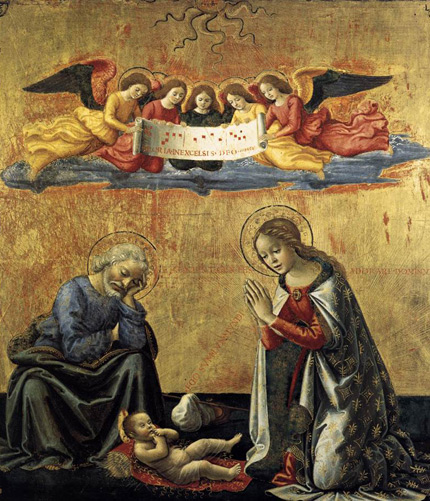
the Sassetti chapel, the Adoration of the Shepherds, is now in the
Florentine Academy. Immediately after disposing of this commission,
Ghirlandajo was asked to renew the frescoes in the choir of S. Maria
Novella. This choir formed the chapel of the Ricci family, but the
Tornabuoni and Tornaquinci families, then much more opulent than
the Ricci, undertook the cost of the restoration, under conditions,
as to preserving the arms of the Ricci, which gave rise in the end
to some amusing incidents of litigation. The frescoes, in the execution
of which Domenico had many assistants, are in four courses along
the three walls,the leading subjects being the lives of the Madonna
and of the Baptist. Besides their general richness and dignity of
art, these works are particularly interesting as containing many
historical portraitsa method of treatment in which Ghirlandajo was
preeminently skilled.
There are no less than twenty-one portraits of
the Tornabuoni and Tornaquinci families; in the subject of the Angel
appearing to Zacharias, those of Politian, Marsilio Ficino and others;
in the Salutation of Anna and Elizabeth, the beautiful Ginevra de
Benci; in the Expulsion of Joachim from the Temple, Mainardi and
Baldovinetti (or the latter figure may perhaps be Ghirlandajo's
father).
The Ricci chapel was reopened and completed in
1490; the altarpiece, now removed from the chapel, was probably
executed with the assistance of Domenico's brothers, David and Benedetto,
painters of ordinary calibre; the painted window was from Domenico's
own design. Other distinguished works from his hand are an altar-piece
in tempera of the Virgin Adored by Sts Zenobius, Justus and others,
painted for the church of St Justus, but now in the Uffizi gallery,
a remarkable masterpiece; Christ in Glory with Romuald and other
Saints, in the Badia of Volterra; the Adoration of the Magi, in
the church of the Innocenti (already mentioned), perhaps his finest
panel-picture (1488); and the Visitation, in the Louvre, bearing
the latest ascertained date (1491) of all his works. Ghirlandajo
did not often attempt the nude; one of his pictures of this character,
Vulcan and his Assistants forging Thunderbolts, was painted for
Lo Spedaletto, but (like several others specified by Vasari) it
exists no longer. Two portraits by him are in the National Gallery,
London. The mosaics which he produced date before 1491; one, of
especial celebrity, is the Annunciation, on a portal of the cathedral
of Florence.
General considerations and assessment
In general artistic attainment Ghirlandajo may
fairly be regarded as exceeding all his precursors or competitors;
though the names of a few, particularly Giotto, Masaccio, Lippo
Lippi and Botticelli, stand higher for originating power. His scheme
of composition is grand and decorous; his chiaroscuro excellent,
and especially his perspectives, which he would design on a very
elaborate scale by the eye alone; his color is more open to criticism,
but this remark applies much less to the frescoes than the tempera-pictures,
which are sometimes too broadly and crudely bright. He worked in
these two methods alone never in oils; and his frescoes are what
the Italian's term buon fresco, without any finishing in tempera.
A certain hardness of outline, not unlike the character
of bronze sculpture, may attest his early training in metal work.
He first introduced into Florentine art that mixture of the sacred
and the profane which had already been practised in Siena. His types
in figures of Christ, the Virgin and angels are not of the highest
order; and a defect of drawing, which has been often pointed out,
is the meagreness of his hands and feet. It was one of his maxims
that painting is designing. Ghirlandajo was an insatiate worker,
and expressed a wish that he had the entire circuit of the walls
of Florence to paint upon. He told his shop-assistants not to refuse
any commission that might offer, were it even for a lady's petticoat-panniers:
if they would not execute such work, he would. Not that he was in
any way glasping or sordid in moneymatters, as is proved by the
anecdote of the readiness with which he gave up a bonus upon the
stipulated price of the Ricci chapel frescoes, offered by the wealthy
Tornabuoni in the first instance, but afterwards begrudged.
Vasari says that Ghirlandajo was the first to abandon
in great part the use of gilding in his pictures, representing by
genuine painting any objects supposed to be gilded; yet this does
not hold good without some considerable exceptions the high lights
of the landscape, for instance, in the Adoration of the Shepherds,
now in the Florence Academy, being put in in gold. Many drawings
and sketches by this painter are in the Uffizi gallery, remarkable
for vigour of outline. One of the great glories of Ghirlandajo is
that he gave some early art education to Michelangelo, who cannot,
however, have remained with him long.
This renowned artist died of pestilential fever
on the 11th of January 1494, and was buried in S. Maria Novella.
He had been twice married, and left six children, three of them
being sons. He had a long and honorable line of descendants, which
came to a close in the 17th century, when the last members of the
race entered monasteries. It is probable that Domenico died poor;
he appears to have been gentle, honorable and conscientious, as
well as energetically diligent.
The paintings are the excellent portrayal of the events and scenes
that we see around us. The painters are the best cameras of the
world. They reproduce many different types of pictures. They even
draw imaginary pictures that do not exist in this world. We tend
to use both thinned oil paints and dense oil paints. Masterpieces
can be dyed more than once, but each time it may be different from
the existing paintings.h
|
|
|
|
|
| |
| | | | | | | | | | | | |
|
|
|