| |
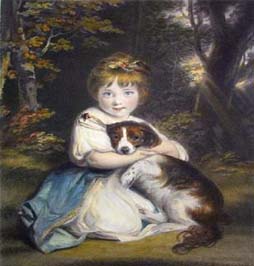
Joshua Reynolds
Sir Joshua Reynolds (July 16, 1723–February 23, 1792) was
the most important and influential of eighteenth-century English
painters, specialising in portraits and promoting the "Grand
Style" in painting which depended on idealization of the imperfect.
He was one of the founders and first President of the Royal Academy.
George III appreciated his merits and knighted him in 1769.
Reynolds was born in Plympton St Maurice, Devon, on 16 July 1723,
and apprenticed in 1740 to the fashionable portrait painter Thomas
Hudson, with whom he remained until 1743. From 1749 to 1752, he
spent over two years in Italy, mainly in Rome, where he studied
the Old Masters and acquired a taste for the "Grand Style".
From 1753 on, he lived and worked in London. He became a close friend
of Dr Johnson, Oliver Goldsmith, Edmund Burke, Henry Thrale, David
Garrick and fellow artist Angelica Kauffmann. He was one of the
earliest members of the Royal Society of Arts: he encouraged that
society's interest in contemporary art and, with Gainsborough, established
the Royal Academy as a spin-out organisation.
With his rival Thomas Gainsborough, he was the dominant English
portraitist of the second half of the 18th century. Reynolds painted
in more of an idealized fashion than his rival. Reynolds was a brilliant
academic. His lectures (Discourses) on art, delivered at the Royal
Academy between 1769 and 1790, are remembered for their sensitivity
and perception. In one of these lectures he was of the opinion that
"invention, strictly speaking, is little more than a new combination
of those images which have been previously gathered and deposited
in the memory." In 1789 he lost the sight of his left eye,
and on 23 February 1792 he died in his house in Leicester Fields,
London. He was buried in St. Paul's Cathedral.
The paintings are the excellent portrayal of the events and scenes
that we see around us. The painters are the best cameras of the
world. They reproduce many different types of pictures. They even
draw imaginary pictures that do not exist in this world. We tend
to use both thinned oil paints and dense oil paints. Masterpieces
can be dyed more than once, but each time it may be different from
the existing paintings.h
|
|
|
|
|
| |
| | | | | | | | | | | | |
|
|
|