|
Max Ernst
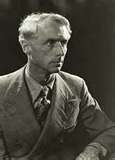
Max Ernst (April 2, 1891 – April 1, 1976) was a German artist.
Max Ernst was born in Brn Germany. In 1909, he enrolled
in the University at Bonn to study philosophy but soon abandoned
the courses to pursue his interest in art. In 1913 he met Guillaume
Apollinaire and Robert Delaunay, and traveled to the Montparnasse
Quarter in Paris where artists from around the world were gathering.
In 1918 he married the art historian Luise Straus — a stormy
relationship that would not last. The next year he visited Paul
Klee and created his first paintings, block prints and collages,
and experimented with mixed media. During World War I he served
in the German army and after the war, filled with new ideas, Max
Ernst, Jean Arp and social activist Alfred Gru formed
the Cologne, Germany Dada group but two years later, in 1922, he
returned to the artistic community at Montparnasse in Paris.
Constantly experimenting, in 1925 he invented frottage, a technique
using pencil rubbings of objects. The next year he collaborated
with Joan Miro on designs for Sergei Diaghilev. With Miras
help, Ernst pioneered grattage in which he troweled pigment from
his canvases.
Ernst drew a great deal of controversy with his 1926 painting The
Virgin Spanking the Christ Child before Three Witnesses: Andre
Breton, Paul eluard, and the Painter.
In Montparnasse he was important in the birth of Surrealism where
artists used illogical images, and used the whims of their psyches
the source of their subject matter. After a period with the Surrealists,
Ernst left the movement due in part to Breton's desire to ostracize
Ernst's friend eluard.
Ernst began to sculpt in 1934, and spent time with Alberto Giacometti.
In 1938, the American heiress and art collector, Peggy Guggenheim,
acquired a number of Ernst's works which she displayed in her new
museum in London.
Ernst developed a fascination with birds that was prevelent in
his work. His alter ego in paintings, that he called Loplop, was
a bird that he suggested was an extension of himself stemming from
an early confusion of birds and humans. He said his sister was born
soon after his bird died. Loplop often appeared in collages of other
artists work, such as collages like Loplop presents Andre
Breton, and they usually had a bird foot-like object superimposed
on another artist's piece. Birds continued to appear in Ernst's
work, such as the post-World War II paintings Angel of Hearth and
Home and Robing of the Bride.
Following the onset of World War II, Ernst was detained as an enemy
alien but with the assistance of the American journalist Varian
Fry in Marseille, he managed to escape the country with Peggy Guggenheim.
They arrived in the United States in 1941 and were married the following
year. Along with other artists and friends (Marcel Duchamp and Marc
Chagall) who had fled from the war and lived in New York City, Ernst
helped inspire the development of Abstract expressionism.
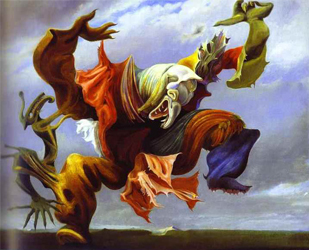
Murdering Airplane, 1920.His marriage to Guggenheim did not last,
and in Beverly Hills, California in October of 1946 in a double
ceremony with Man Ray and Juliet Bowser he married Dorothea Tanning.
Ernst remained primarily in the United States, living in Sedona,
Arizona, and in 1948 wrote the treatise Beyond Painting before visiting
Europe in 1950. He returned to Paris permanently in 1953 and the
following year he won the Venice Biennale. As a result of the publicity,
he began to achieve financial success.
In 1963 he and Tanning moved to a small town in the south of France
where he continued to work. He designed stage sets and a fountain
for the city of Ambois. In 1975, a retrospective of his works was
held at the Solomon R. Guggenheim Museum in New York City, and the
Galeries Nationales du Grand-Palais in Paris published a complete
catalogue of his works.
Ernst died on April 1, 1976, in Paris, France and was interred
there in the Pere Lachaise Cemetery.
The paintings are the excellent portrayal of the events and scenes
that we see around us. The painters are the best cameras of the
world. They reproduce many different types of pictures. They even
draw imaginary pictures that do not exist in this world. We tend
to use both thinned oil paints and dense oil paints. Masterpieces
can be dyed more than once, but each time it may be different from
the existing paintings.h
|
|
|
|
|
| |
| | | | | | | | | | | | |
|