| |
Paul Klee
Paul Klee (December 18, 1879 – June 29, 1940) was a German
painter.
Das Licht und Etliches (1931)Klee was born in Münchenbuchsee
(near Bern), Switzerland, into a musical family - his father, Hans
Klee, taught music at the Hofwil Teacher Seminar near Berne. In
his early years, Paul wanted to be a musician, but decided on the
visual arts in his teen years. He studied art at the Academy of
Fine Arts in Munich with Heinrich Knirr and Franz von Stuck. After
travelling to Italy and then back to Bern, he settled in Munich,
where he met Wassily Kandinsky, Franz Marc, and other avant-garde
figures, and became associated with the Blaue Reiter. Here he met
Bavarian pianist Lily Stumpf, whom he married; they had one son.
In 1914, he visited Tunisia and was impressed by the quality of
the light there, writing "Color has taken possession of me;
no longer do I have to chase after it, I know that it has hold of
me forever ... Color and I are one. I am a painter."
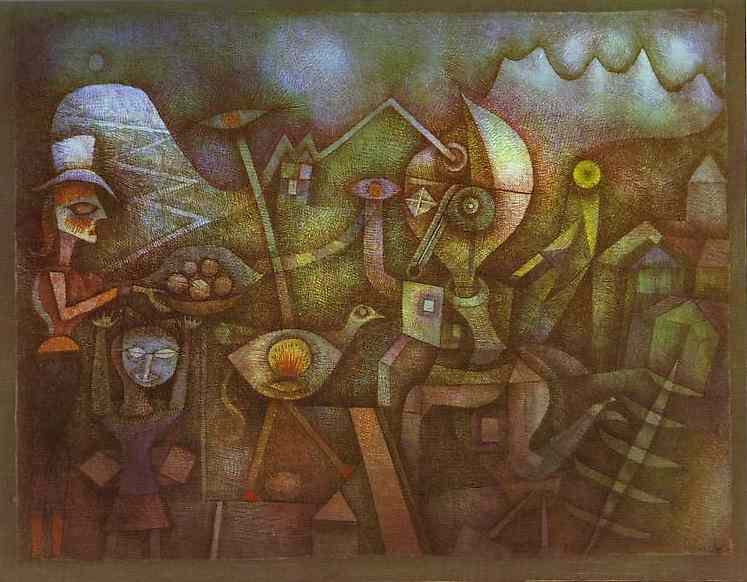
Klee worked with many different types of media – oil paint,
watercolor, ink, and more. He often combined them into one work.
He has been variously associated with expressionism, cubism and
surrealism but his pictures are difficult to classify. They often
have a fragile child-like quality to them, and are usually on a
small scale. They frequently allude to poetry, music and dreams
and sometimes include words or musical notation. The later works
are distinguished by spidery hieroglyph-like symbols. His better
known works include Southern (Tunisian) Gardens (1919), Ad Parnassum
(1932), and Embrace (1939).
Following World War I, in which he fought as part of the imperial
German army, Klee taught at the Bauhaus, and from 1931 at the Düsseldorf
Academy, before being denounced by the Nazi Party for producing
"degenerate art".
Composer Gunther Schuller also immortalized seven works of Klee's
in his Seven Studies on Themes of Paul Klee. The studies are based
on a range of works, including Alter Klang [Antique Harmonies],
Abstraktes Terzett [Abstract Trio], Little Blue Devil, Twittering
Machine, Arab Village, Ein unheimlicher Moment [An Eerie Moment],
and Pastorale.
In 1933, Paul Klee returned to Switzerland; in 1935, he was diagnosed
with scleroderma. The progression of his disease can be followed
through the art he created in his last years.
He died in Muralto, Switzerland, in 1940 without having obtained
the Swiss citizenship.
Today, a painting by Paul Klee can sell for as much as US$7.5 million.
A museum dedicated to Paul Klee was built in Bern, Switzerland,
by the Italian architect Renzo Piano. It opened in June 2005. It
houses a collection of about 4000 art works by Paul Klee. Around
200 pieces of art are on display.
The paintings are the excellent portrayal of the events and scenes
that we see around us. The painters are the best cameras of the
world. They reproduce many different types of pictures. They even
draw imaginary pictures that do not exist in this world. We tend
to use both thinned oil paints and dense oil paints. Masterpieces
can be dyed more than once, but each time it may be different from
the existing paintings.h
|
|
|
|
|
| |
| | | | | | | | | | | | |
|
|
|