In Antwerp, his mother apprenticed Rubens to leading painters of the time.
In 1600, he went to Italy, where he worked as a court painter to the duke of Mantua. He studied ancient Roman art and learned by copying the works of the Italian masters. His mature style was profoundly influenced by Titian.
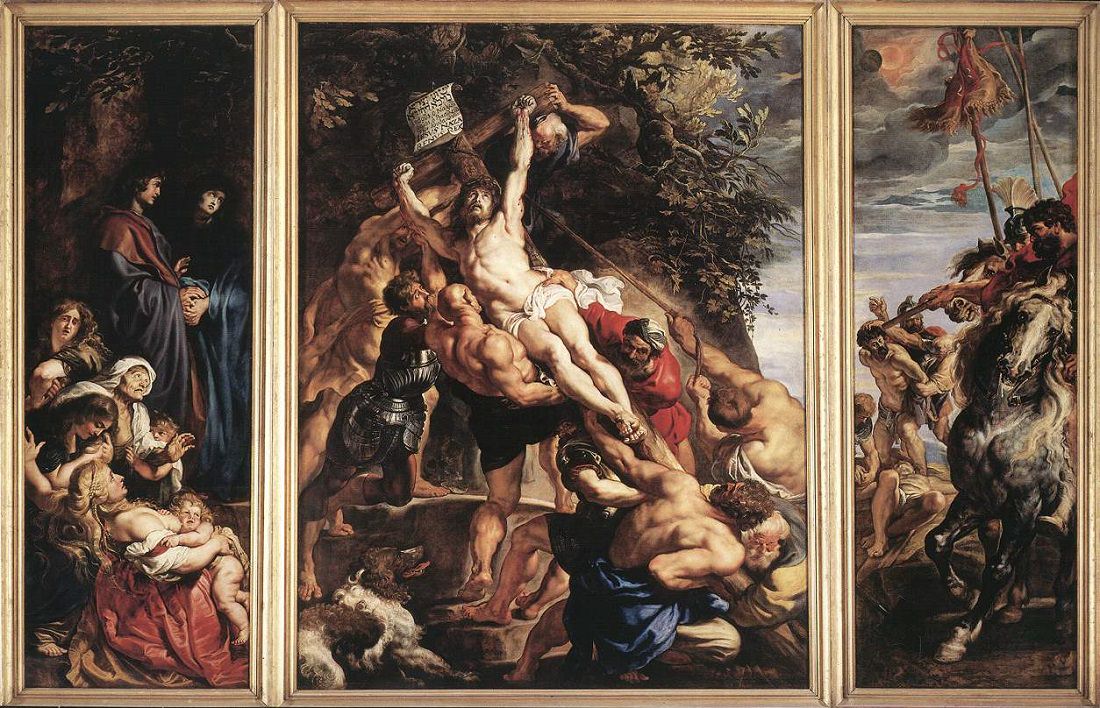
Upon the death of his mother in 1608, Rubens returned to Antwerp. A year later, he married Isabella Brant, the daughter of Jan Brant, a leading Antwerp humanist. His altar pieces The Raising of the Cross (1610) and The Descent of the Cross (1611–1614) for the Cathedral of Our Lady established Rubens as Flanders' leading religious painter.
He received numerous commissions from the French court, including a series of allegorical paintings on the life of Marie de' Medici (now in the Louvre). He and his workshop executed many monumental religious paintings, such as the Assumption of the Virgin Mary in the Cathedral of Antwerp.
The Raising of the Cross, Cathedral of Our Lady , AntwerpIn the period between 1621 and 1630, the Spanish Habsburg rulers entrusted Rubens with a number of diplomatic missions. King Charles I of England knighted him for his diplomatic efforts to bring about a peace treaty between England and Spain. He was also commissioned to paint the ceiling of the Banqueting House at the Palace of Whitehall.
Hélène Fourment with two of her children, c. 1636.In 1630, four years after the death of his first wife, the 53-year-old painter married 16-year-old Helen Fourment. Rubens had three children with Isabella and five with Helen; his youngest child was born eight months after his death. Helen's charms recur in later works such as The Garden of Love, The Three Graces and The Judgment of Paris, which he painted for the Spanish court and are now in the Prado.
Rubens died of gout at age 63, and was interred in Saint James' church, Antwerp.
At a Sotheby's auction on July 10, 2002, Rubens' painting The Massacre of the Innocents sold for £49.5million ($76.2 million) to Lord Thomson.
Portrait of Marie de' Medici. c. 1622. Oil on canvas. Museo del Prado, Madrid, SpainHis picture in the National Gallery, London, The Allegory of Peace and War (1629), reflects, and even illustrates, his strong concern for peace. It was given to King Charles I and helped to create a peace treaty between London and Madrid. He visited the Netherlands which was "enemy territory" partly to meet Dutch artists and partly to seek political reconciliation. It was there that he encountered the attitude that courtiers should not use their hands in any art or craft. But because he was such a fine artist, King Philip and King Charles both enjoyed his company as well as his art.