| |
Philip Guston
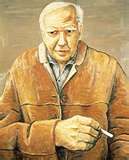
Philip Guston (Montreal, Canada, July 27, 1913 - Woodstock, N.Y.,
June 7, 1980) was a notable member of the New York School, which
also numbered many of the Abstract Expressionists, such as Jackson
Pollock and Willem De Kooning, as well a painter that lead the transition
from Modernism to Post-Modernism in painting. Born Philip Goldstein
in Montreal, Canada, Guston, with his family, moved to Los Angeles
as a child. He began painting at the age of 14, and in 1927 he enrolled
in the Los Angeles Manual Arts High School where he, and Jackson
Pollock, studied under John de St. Vrain Schwankovsky where they
were introduced to Modern European art, oriental philosophy, theosophy
and mystic literature. Apart from his high school education and
a one-year scholarship at the Otis Art Institute in Los Angeles,
Guston remained, largely, a self-taught artist.
In 1936, Guston moved to New York, and worked as an artist under
the WPA scheme. During this period his work can be typified by strong
references to Renaissance painters such as Paolo Uccello, Masaccio,
and Giotto. These references can be found by his sometimes awkward,
but always calculated, draughtsmanship of the figure. Influences
of the American Regionalists and Mexican mural painters can also
be found. During this period he accepts a teaching position at Washington
University, St. Louis. He holds this position from 1945-1947.
In the 1950s, Guston achieved success as a second-generation Abstract
Expressionist. His paintings, done in a style he dubbed "Abstract
Impressionism," generally consisted of one to several masses
of color floating around the middle of the canvas.
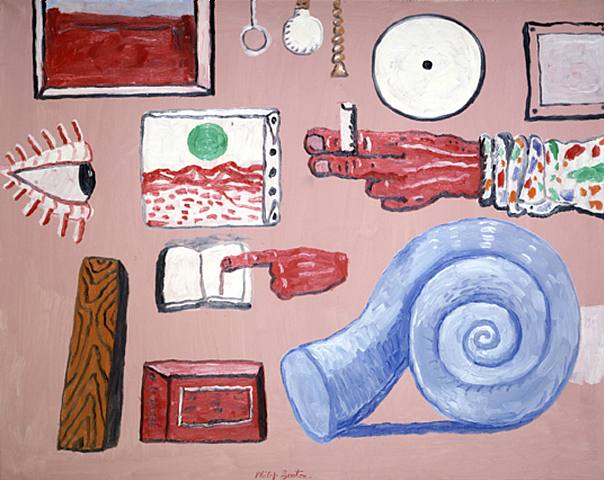
In the late 1960s, he became tired of the purity associated with
abstraction and began painting representational subjects again,
but in a cartoonish manner. When attacked about the impurity of
his later paintings, he responded, "There is something ridiculous
and miserly in the myth we inherit from abstract art. That painting
is autonomous, pure and for itself, therefore we habitually analyze
its ingredients and define its limits. But painting is 'impure'.
It is the adjustment of 'impurities' which forces it coninuity.
We are image-makers and image-ridden. There are no wiggly or straight
lines..." In this body of work he creates a lexicon of images
such as Klansmen, lightbulbs, shoes, interiors, and cyclopses. Guston
is best known for these late existential and lugubrious paintings,
which at the time of his death in 1980 reached a wide audience,
and brought him to the attention of many painters, and many imitators.
The paintings are the excellent portrayal of the events and scenes
that we see around us. The painters are the best cameras of the
world. They reproduce many different types of pictures. They even
draw imaginary pictures that do not exist in this world. We tend
to use both thinned oil paints and dense oil paints. Masterpieces
can be dyed more than once, but each time it may be different from
the existing paintings.h
|
|
|
|
|
| |
| | | | | | | | | | | | |
|
|
|