Pieter Brueghel the Elder

Pieter Brueghel the Elder or Bruegel (c.1525 – September 9, 1569) was a Flemish painter known for his landscapes and peasant scenes. There are records that he was born in Broghel near Breda, but it is unsure whether the Dutch town of Breda or the Belgian town of Bree, called Breda in Latin, is meant. From 1559 he dropped the 'h' from his name and started signing his paintings as Bruegel.

He was an apprentice of Pieter Coecke van Aelst, whose daughter Mayke he later married, and was in 1551 accepted as a master in the painters' guild of Antwerp. He travelled to Italy soon after, and then returned to Antwerp before settling in Brussels permanently 10 years later. He died there on 9 September 1569.

He was the father of Pieter Brueghel the Younger and Jan Brueghel the Elder who both became painters, but as they were still infants when their father died; neither received any training from him.

Bruegel specialised in landscapes populated by peasants, painted in a simpler style than the Italianate art that prevailed at the time. The most obvious influence on his art is the older Dutch master Hieronymus Bosch. He is nicknamed 'Peasant Brueghel' to distinguish him from other members of the Brueghel dynasty, but is also the one generally meant when the context does not make clear which "Brueghel" is being referred to.

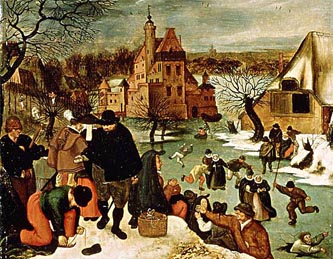
He is often credited as being the first western painter to paint landscapes for their own sake, rather than as a backdrop to a religious allegory. His winter landscapes of 1565 are corroborative evidence of the severity of winters during the Little ice age.

Works

Bruegel's Netherlandish Proverbs, 1559, with peasant scenes illustrating over 100 proverbs
The Tower of Babel 1563, oil on board
A detail of Children Playing
The Peasant Wedding 1568
Winter Landscape with a Bird TrapLarge Fish Eat Small Fish 1556, Albertina, Vienna
Ass at School 1556, Kupferstichkabinett Staatliche Museen, Berlin
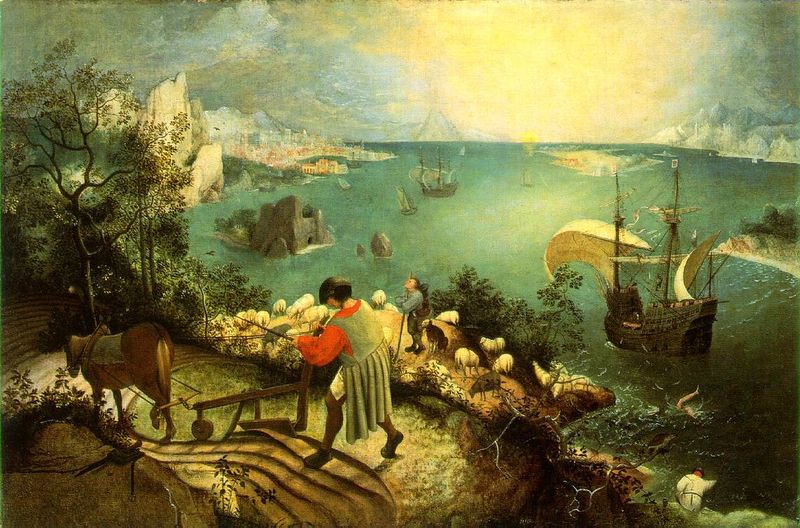
[Landscape with the Fall of Icarus] c.1558, Musée des Beaux-Arts, Brussels
Netherlandish Proverbs 1559, Staatliche Museen zu Berlin - Gemaldegalerie, Berlin

The Fight Between Carnival and Lent 1559, Kunsthistorisches Museum Wien, Vienna
Children's Games 1560, Kunsthistorisches Museum Wien, Vienna
Saul (Battle Against The Filistines On The Gilboa) 1562, Kunsthistorisches Museum Wien, Vienna
Two Small Monkeys 1562, Staaliche Museen, Gemaldegalerie, Berlin
The Triumph of Death c. 1562, Museo del Prado, Madrid
Dulle Griet (Mad Meg) c. 1562, Museum Mayer van den Bergh, Antwerp
The Tower of Babel 1563, Kunsthistorisches Museum Wien, Vienna
Flight To Egypt 1563, Courtauld Institute Galleries, London
The "Little" Tower of Babel c. 1563, Museum Boymans-van Beuningen, Rotterdam

The Procession to Calvary 1564, Kunsthistorisches Museum Wien, Vienna
The Adoration of the Kings 1564, The National Gallery, London
The Months. A cycle of 6 or 12 paintings of the months or seasons from the Book of hours of which five remain:
The Hunters in the Snow (Dec.-Jan.) 1565, Kunsthistorisches Museum Wien, Vienna
The Gloomy Day (Feb.-Ma.) 1565, Kunsthistorisches Museum Wien, Vienna
Hay-Harvest (June-July) 1565, National Museum, Prague
The Harvesters (Aug.-Sept.) 1565, Metropolitan Museum of Art, New York
The Return of the Herd (Oct.-Nov.) 1565, Kunsthistorisches Museum Wien, Vienna
Winter Landscape with a Bird Trap 1565, Wiltshire, Wilton House
The Calumny of Apelles 1565, British Museum, London
Massacre of the Innocents c. 1565, Hampton Court, U.K./Kunsthistorisches Museum Wien, Vienna
The Painter and the Connoisseur c. 1565, Albertina, Vienna
Preaching Of John The Baptist 1566, Beaux Arts Museum, Budapest
Census at Bethlehem 1566, Musée des Beaux-Arts, Brussels
The Wedding Dance c. 1566, Detroit Institute of Arts, Detroit
Conversion Of Paulus 1567, Kunsthistorishes Museum Wien, Vienna
The Land of Cockaigne/Land Of Milk And Honey 1567, Alte Pinakothek, Munich
The Blind Leading the Blind 1568, Museo Nazionale, Napoli
The Peasant Wedding 1568, Kunsthistorisches Museum Wien, Vienna
The Peasant Dance 1568, Kunsthistorisches Museum Wien, Vienna
The Beggars 1568, Louvre, Paris
The Peasant and the Nest Robber 1568, Kunsthistorisches Museum Wien, Vienna
The Death of the Virgin
The Fall of the Rebel Angels, Musée des Beaux-Arts, Brussels


The paintings are the excellent portrayal of the events and scenes that we see around us. The painters are the best cameras of the world. They reproduce many different types of pictures. They even draw imaginary pictures that do not exist in this world. We tend to use both thinned oil paints and dense oil paints. Masterpieces can be dyed more than once, but each time it may be different from the existing paintings.h

Sitemap
Painter sitemap
Techniques sitemap
Materials sitemap


famous paintings | famous painters | painting styles | famous artists | mixed media painting | painting technique | oil paintings | canvas painting | life oil painting still | abstract art paintings | modern art work | fine art painting landscape | oil painting reproductions - media | history of paintings | oil painting - idioms | links | review painting articles | review painting news | press release