| |
Pieter de Hooch
Pieter de Hooch (pronounced Hoak, also spelled "Hoogh"
or "Hooghe") (1629 - 1684) was a genre painter during
the Dutch Golden Age. He was a contemporary of Dutch Master Jan
Vermeer, with whom his work shared themes and style.
De Hooch was born in Rotterdam to Hendrick Hendricksz de Hooch,
a bricklayer, and Annetge Pieters, a midwife. Though de Hooch's
exact birthdate is unknown, his baptism was recorded on December
29, 1629. He was the eldest of five children and outlived all of
his siblings. He studied art in Haarlem under the landscape painter,
Nicolaes Berchem. Beginning in 1650, he worked as a painter and
servant for a linen-merchant and art collector named Justus de la
Grange. His service for the merchant required him to accompany him
on his travels to the Hague, Leiden, and Delft, to which he eventually
moved. It is likely that de Hooch handed over most of his works
to la Grange during this period in exchange for board and other
benefits, as this was a common commercial arrangement for painters
at the time, and a later inventory recorded that la Grange possessed
eleven of his paintings.
De Hooch was married in Delft in 1654 to Jannetje van der Burch,
by whom he fathered seven children. While in Delft, de Hooch is
also believed to have learned from the painters Carel Fabritius
and Nicolaes Maes, who were both early members of the Delft School.
He became a member of the painters' St. Lukas Guild in 1655, and
had moved to Amsterdam by 1661.
The early work of de Hooch, like most young painters of his time,
was mostly composed of scenes of soldiers in stables and taverns,
though he used these to develop great skill in light, color, and
perspective rather than to explore an interest in the subject matter.
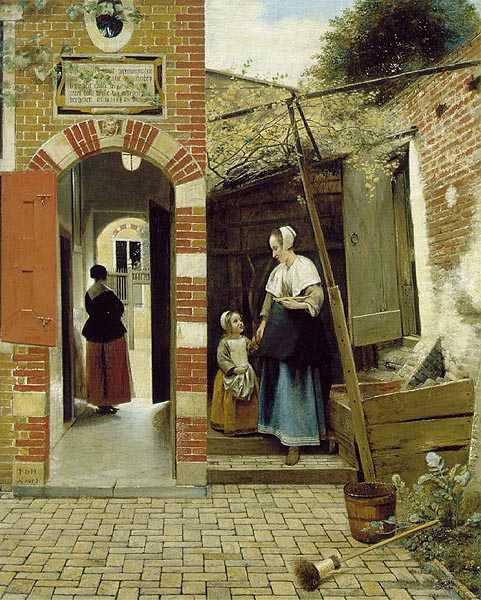
After beginning his family in the mid-1650s, he switched his focus
to domestic scenes and family portraits. His work showed astute
observation of the mundane details of everyday life while also functioning
as well-ordered morality tales. These paintings often exhibited
a sophisticated and delicate treatment of light similar to those
of Vermeer, who lived in Delft at the same time as de Hooch. 19th
century art historians had assumed that Vermeer had been influenced
by de Hooch's work, but the opposite is now believed.
Though he began to paint for wealthier patrons in Amsterdam, he
lived in the poorest areas of the city. Around this time, de Hooch's
painting style became coarser and darker in color, and his simple
domestic scenes were replaced by highly-decorated images set in
palatial halls and country villas. Most scholars believe that de
Hooch's work after around 1670 became more stylized and deteriorated
in quality. It has been surmised that this was in part due to deteriorating
health; de Hooch died in 1684 in an Amsterdam insane asylum, though
how he came to be there is unrecorded.
The paintings are the excellent portrayal of the events and scenes
that we see around us. The painters are the best cameras of the
world. They reproduce many different types of pictures. They even
draw imaginary pictures that do not exist in this world. We tend
to use both thinned oil paints and dense oil paints. Masterpieces
can be dyed more than once, but each time it may be different from
the existing paintings.h
|
|
|
|
|
| |
| | | | | | | | | | | | |
|
|
|