| |
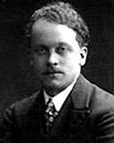
Raoul Dufy
Raoul Dufy (June 3, 1877 – March 23, 1953) was a French
Fauvist painter born in Le Havre in Normandy. He developed a colourful,
decorative style that became fashionable for designs for ceramics,
textiles and decorative schemes for public buildings. He is noted
for scenes of open-air social events.
Dufy was born at Le Havre, one of a family of nine members. He
left school at the age of 14 to work in a coffee importing company.
In 1895 when he was 18, he started evening classes in art at Le
Havre ecole des Beaux-Arts. He and Othon Friesz, a school
friend, studied the works of Eugene Boudin in the museum
in Le Havre.
Raoul Dufy, Regatta at Cowes, (1934), Washington D.C. National
Gallery of Art.In 1900, after a year of military service, he won
a scholarship enabling him to attend the ecole Nationale
des Beaux-Arts in Paris, where he was a fellow student of Georges
Braque. The impressionist landscapists, such as Claude Monet and
Camille Pissarro, influenced him
Introduced to Berthe Weill in 1902, she showed his work in her
gallery. Henri Matisse's Luxe, Calme et Volupte, which Dufy
saw at the Salon des Independants in 1905, was a revelation
to the young artist and directed his interest towards Fauvism. Les
Fauves (wild beasts) emphasised bright colour and rich bold contours
in their work, and Dufy’s painting reflects this approach
until about 1909, when contact with the work of Paul Cezanne
led him to adopt a somewhat subtler technique. It was not until
1920, after he had flirted briefly with yet another style, cubism,
that Dufy developed his own distinctive approach involving skeletal
structures, arranged in a diminished perspective, and the use of
light washes of colour put on by swift brush strokes in a manner
that came to be known as stenographic.
Dufy's cheerful oils and watercolours depict yachting scenes, sparkling
views of the French Riviera, chic parties and musical events. The
optimistic and fashionably decorative and illustrative nature of
much of his work has meant that his output is less highly critically
valued than artists who treat a wider range of social concerns.
In 1938, Dufy completed one of the largest paintings ever done,
a huge and immensely popular epic to electricity, the fresco La
Fee Electicite for the Exposition Internationale in
Paris.
Dufy also acquired a reputation as an illustrator and an applied
artist. He changed the face of fashion and fabric design with his
work for Paul Poiret. He painted murals for public buildings, and
produced a prodigious number of tapestries and ceramic designs.
His plates appear in books by Guillaume Apollinaire, Stephane
Mallarme and Andre Gide.
Dufy died near Forcalquier, France, on March 23, 1953, and was
buried not far from Matisse in the Cimiez Monastery Cemetery in
Cimiez, a suburb of the city of Nice, France.
The paintings are the excellent portrayal of the events and scenes
that we see around us. The painters are the best cameras of the
world. They reproduce many different types of pictures. They even
draw imaginary pictures that do not exist in this world. We tend
to use both thinned oil paints and dense oil paints. Masterpieces
can be dyed more than once, but each time it may be different from
the existing paintings.h
|
|
|
|
|
| |
| | | | | | | | | | | | |
|
|
|