| |
Richard Estes
Richard Estes is an american painter born in 1936 in Illinois.
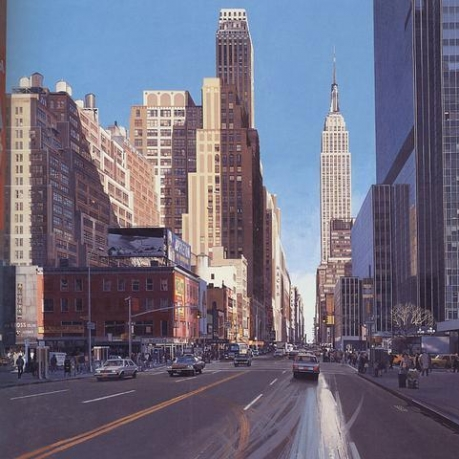
who is best known for his hyper-realistic art. The paintings consist
of reflective, clean, illustrative, inanimate city and geometric
landscapes.
Richard Estes is regarded as one of the founders of the international
Photo-Realist movement of the late 1960s and 70s, together with
painters like Malcolm Morley, Chuck Close and Duane Hanson. Their
work exhibits a high finish, fine details and an almost photographic
fidelity to reality. This type of painting stands in the traditional
of: trompe l'oeil (a style of painting dating from the Renaissance,
which developed in response to the discovery of perspective in 15th
century Italy and advances in optics in 17th century Holland) and
17th century Dutch painting (Vermeer, Van Dyke, Franz Hals, Jan
Steen, Rembrandt) with its exacting technique and highly finished
surfaces.
Estes was born in 1932 in Kewanee, Illinois. He moved to Chicago
at an early age and studied fine arts from 1952 to 1956, with a
concentration on figure drawing and traditional academic painting,
at the School of the Art Institute of Chicago. He frequently studied
the works of realist painters such as Degas, Hopper and Eakins,
who are strongly represented in the Art Institute's collection.
Estes moved to New York City in 1956, after he had completed his
course of studies, and worked for the next ten years as a graphic
artist for various magazine publishers and advertising agencies
in New York and Spain. During this period he painted in his spare
time, and by 1966 he had saved enough money so that he could devote
himself full-time to painting. Most of Estes' paintings from the
early 60's are of New Yorkers engaged in everyday activities. It
was around 1967 that a shift occurred in his city scenes: he began
to paint storefronts and buildings with glass windows partially
reflecting images of the street scene in front of the building.
These paintings were based on color photographs he would make of
his object, which trapped the evanescent nature of the reflections,
which would change in part with the lighting and the time of day.
While some amount of alteration was done for the sake of aesthetic
composition, it was important to Estes that the central and the
main reflected objects be recognizable, but also that the evanescent
quality of the reflections be retained. Estes had his first of many
one-man shows in 1968, at the Allan Stone Gallery in New York.
The paintings are the excellent portrayal of the events and scenes
that we see around us. The painters are the best cameras of the
world. They reproduce many different types of pictures. They even
draw imaginary pictures that do not exist in this world. We tend
to use both thinned oil paints and dense oil paints. Masterpieces
can be dyed more than once, but each time it may be different from
the existing paintings.h
|
|
|
|
|
| |
| | | | | | | | | | | | |
|
|
|