| |
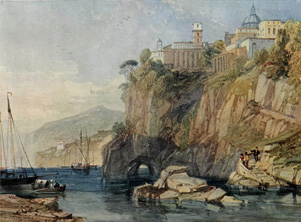
Samuel Prout
Samuel Prout (September 17, 1783 - February 10, 1852) was an English
water-colour painter.
He was born at Plymouth, and spent whole summer days, in company
with Benjamin Haydon, drawing the quiet cottages, rustic bridges
and romantic watermills of the beautiful valleys of Devon. He made
a journey through Cornwall to try his hand in furnishing sketches
for Britton's Beauties of England. In 1803 he moved to London, where
he stayed until 1812. In London, Prout saw new possibilities, and
endeavoured to correct and improve his style by studying the works
of the rising school of landscape. To earn a living, he painted
marine pieces for Palser the printseller, took students, and published
drawing books for learners. He was one of the first to use lithography
in his artwork.
It was not however until about 1818 that Prout discovered his niche.
Happening time to make his first visit to the Continent, and to
study the quaint streets and market-places of continental cities,
he suddenly found himself in a new and enchanting province of art.
His eye caught the picturesque features of the architecture, and
his hand recorded them with skill. The composition of his drawings
was exquisitely natural; their colour exhibited "the truest
and happiest association in sun and shade"; the picturesque
remnants of ancient architecture were rendered with the happiest
breadth and largeness, with the heartiest perception and enjoyment
of their time-worn ruggedness; and the solemnity of great cathedrals
was brought out with striking effect. At the time of his death there
was hardly a place in France, Germany, Italy (especially Venice)
or the Netherlands where his face had not been seen searching for
antique gables and sculptured pieces of stone.
The paintings are the excellent portrayal of the events and scenes
that we see around us. The painters are the best cameras of the
world. They reproduce many different types of pictures. They even
draw imaginary pictures that do not exist in this world. We tend
to use both thinned oil paints and dense oil paints. Masterpieces
can be dyed more than once, but each time it may be different from
the existing paintings.h
|
|
|
|
|
| |
| | | | | | | | | | | | |
|
|
|