Simon Vouet

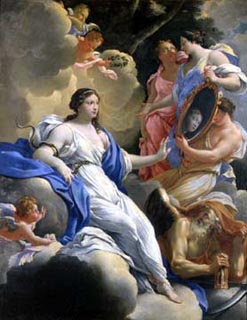
Simon Vouet (1590 - 1649) was the French painter and draftsman who introduced the Italian Baroque style to France. A French contemporary, lacking the term "Baroque," said, "In his time the art of painting began to be practiced here in a nobler and more beautiful way than ever before," and the allegory of "Riches" (illustration, right) demonstrates a new heroic sense of volumes, a breadth and confidence without decorative mannerisms. Vouet's new style was distinctly Italian, after his years of study in Italy, from 1613 to 1627, mostly in Rome where the Baroque style was originating in these years, but he also visited Venice, Bologna, where the Caracci had their academy, and Genoa and Naples.

Vouet was a natural academic, who studied and absorbed everything in his environment and distilled them: Caravaggio dramatic lighting, Italian Mannerism, Paolo Veronese's color, and the art of the Carracci, Guercino, and Guido Reni. Famous and respected, he was president of Rome's Accademia di San Luca, when Louis XIII called him to France.

In Paris, Vouet was the fresh dominating force, painting public altarpieces and allegorical decors for private patrons. Vouet's atelier produced a whole school of French painters for the following generation, and through Vouet French Baroque painting retained a classicizing restraint from the outset. Compare French Baroque artists Philippe de Champaigne, Nicolas Poussin and above all, Charles le Brun, his most influential pupil, who organized all the interior decorative painting at Versailles and dictated official style at the court of Louis XIV of France, but who jealously excluded Vouet from the Académie Royale in 1648. Vouet's other students included Valentin de Boulogne, the main figure of the French "Caravaggisti", Pierre Mignard, Eustache Le Sueur, Nicolas Chaperon, Claude Mellan and the Flemish artist Abraham Willaerts.


The paintings are the excellent portrayal of the events and scenes that we see around us. The painters are the best cameras of the world. They reproduce many different types of pictures. They even draw imaginary pictures that do not exist in this world. We tend to use both thinned oil paints and dense oil paints. Masterpieces can be dyed more than once, but each time it may be different from the existing paintings.h

Sitemap
Painter sitemap
Techniques sitemap
Materials sitemap


famous paintings | famous painters | painting styles | famous artists | mixed media painting | painting technique | oil paintings | canvas painting | life oil painting still | abstract art paintings | modern art work | fine art painting landscape | oil painting reproductions - media | history of paintings | oil painting - idioms | links | review painting articles | review painting news | press release | Kids Costumes | Women costumes