Theo van Doesburg

Theo van Doesburg (Utrecht, August 30, 1883 – Davos, March 7, 1931) was a Dutch artist, practicing in painting, writing, poetry and architecture. He is most famously known as the founder and leader of De Stijl.

Biography

Early life

Theo van Doesburg was born as Christiaan Emil Marie Küpper on August 30 1883 in Utrecht as the son of the photographer Wilhelm Küpper and Henrietta Catherina Margadant. Early in his twenties he started using the name of his stepfather Theodorus Doesburg to sign his early paintings. He supported his works by copying paintings from the Rijksmuseum and writing for magazines.

Founding of 'De Stijl'

It was while reviewing an exposition for one of these magazines, in 1915, that he came in contact with the works of Piet Mondrian, who was eight years older than him, and had then already gained some attention with his paintings. Van Doesburg saw in these paintings his ideal in painting: a complete abstraction of reality. Soon after the exposition Van Doesburg got in contact with Mondrian, and together with other similar-minded artists such as Bart van der Leck, Anthony Kok, Vilmos Huszar and J.J.P. Oud they founded the magazine De Stijl in 1917.

Van Doesburg promoting 'De Stijl'

Although 'De Stijl' was made up of many members Van Doesburg was the 'ambassador' of the movement, promoting it across Europe. He moved to Weimar in 1922, deciding to make an impression on the Bauhaus principal, Walter Gropius, in order to spread the influence of the movement.

Although Gropius accepted a turn towards constructivism in 1923, he did not feel that Doesburg could become a Bauhaus master. Doesburg then installed himself near to the Bauhaus buildings and started to attract school students interested in the new ideas of constructivism.

The split with Mondrian

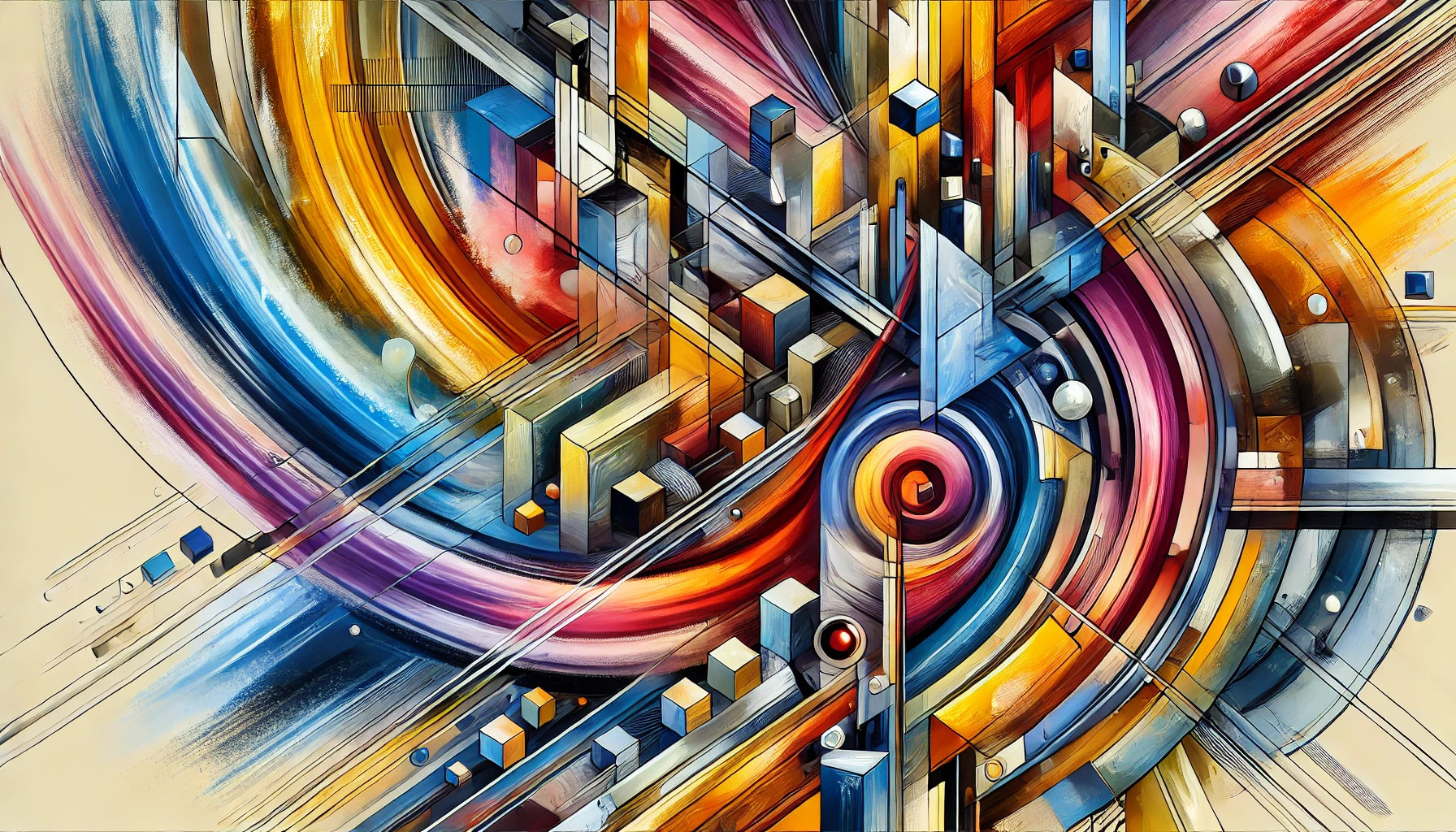
"Counter-Composition V" (1924)The friendship between Van Doesburg and Mondrian remained strong in these years, although their primary way of communication was by letter. In 1923 Van Doesburg moved to Paris together with his wife Nelly van Doesburg. Because the two men got to see each other on a much more regular basis the differences in character became apparent: Mondrian was introvert, while van Doesburg was more flamboyant and extravagant. During 1924 the two men had disagreements, which eventually lead to a (temporary) split in the same year. The exact reason of this split has been a point among art historians: usually the divergent ideas about the directions of the lines in the paintings have been named as the primary reason: Mondrian never accepted diagonals, whereas Doesburg insisted on the diagonal's dynamic aspects, and indeed featured it in many of his works. However, Mondrian accepted some concepts of diagonals, such as in his "Lozenge" paintings, where the canvas was rotated 45 degrees, while still maintaining horizontal lines. In recent years, however, this theory gained critique from art historians such as Carel Blotkamp who cites their different concepts about space and time as the main reason for the split. After the split Van Doesburg launched a new concept for his art: Elementarism, which was characterized by the diagonal lines and rivalled with Mondrians Neo-Plasticism.

Activities other than painting

Van Doesburg had other activities apart from painting and promoting De Stijl: he made efforts in architecture, designing houses for artists, together with Georges Vantongerloo and he designed the decoration for the Café Aubette in Strasbourg. Van Doesburg also kept a link with DADA, publishing the magazine DADA Holland under the false name of I. K. Bonset. He also published Dada poetry under the same name in De Stijl. Together with El Lissitzky and Kurt Schwitters, Van Doesburg pioneered the efforts to an International of Arts in two congresses held in Düsseldorf and Weimar, in 1922.


The paintings are the excellent portrayal of the events and scenes that we see around us. The painters are the best cameras of the world. They reproduce many different types of pictures. They even draw imaginary pictures that do not exist in this world. We tend to use both thinned oil paints and dense oil paints. Masterpieces can be dyed more than once, but each time it may be different from the existing paintings.h

Sitemap
Painter sitemap
Techniques sitemap
Materials sitemap


famous paintings | famous painters | painting styles | famous artists | mixed media painting | painting technique | oil paintings | canvas painting | life oil painting still | abstract art paintings | modern art work | fine art painting landscape | oil painting reproductions - media | history of paintings | oil painting - idioms | links | review painting articles | review painting news | press release | Kids Costumes | Women costumes