Oil painting -> List of Painters -> Thomas John Thomson
Thomas John Thomson
 |
Personal Details
|
Tom Thompson was a Canadian painter who was a major figure in the development of modern art in Canada. He was born in 1877 in Ontario and began his artistic career as a commercial artist before joining the Arts and Crafts Movement. Thompson was a self-taught artist whose style evolved from a traditional landscape painting style to a more expressionistic approach.
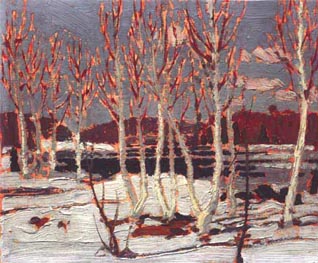
Thompson was an influential figure in the Group of Seven, a group of Canadian landscape painters who sought to create a distinctively Canadian style of painting. He was the first president of the Group of Seven and was a major force in the development of their style. His works often featured vivid colors and depictions of the Canadian wilderness, and he was known for his use of bold brushstrokes.
Thompson was also a major figure in the development of the Canadian arts scene. He was an active member of the Royal Canadian Academy of Arts and the Ontario Society of Artists, and he served as the president of the Ontario Society of Artists from 1917 to 1921.
He was also an advocate for the establishment of an art school in Toronto, which eventually became the Ontario College of Art. Thompson's works have been exhibited in many galleries and museums around the world, including the National Gallery of Canada, the Art Gallery of Ontario, and the Tate Modern in London. He was highly regarded by his contemporaries and received recognition for his work, including the Order of Canada in 1972.
Thompson's life was tragically cut short in 1917, when he died at the age of 39 in a canoeing accident on Canoe Lake near Algonquin Park. His death left a lasting impact on the Canadian art scene, as his works remain some of the most iconic and influential of the Group of Seven.
Tom Thompson's legacy lives on in the works of the Group of Seven, which continue to inspire Canadian artists and art lovers alike. His influence on the development of modern Canadian art is undeniable, and his work remains an important part of the Canadian art scene.
Works Of Thomas John Thomson:
|
|