| |
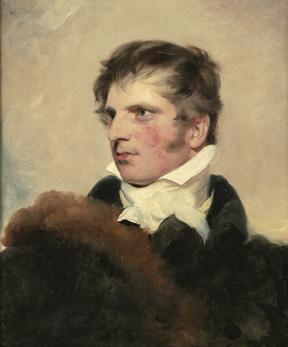
Thomas Lawrence
Sir Thomas Lawrence (April 13, 1769 – January 7, 1830),
an English painter, was born at Bristol.
His father was an innkeeper, first at Bristol and afterwards at
Devizes, and at the age of six Thomas was already shown off to the
guests of the Black Boar as an infant prodigy who could sketch their
likenesses and declaim speeches from Milton. In 1779 the elder Lawrence
had to leave Devizes, having failed in business and the precocious
talent of the son, who had gained a reputation along the Bath road,
became the support of the family. His debut as a crayon portrait
painter was made at Oxford, where he was well patronized, and in
1782 the family settled in Bath, where the young artist soon found
himself fully employed in taking crayon likenesses of the fashionables
of the place at a guinea or a guinea and a half a head. In 1784
he gained the prize and silver-gilt palette of the Society of Arts
for a crayon drawing after Raphael's "Transfiguration,"
and presently beginning to paint in oil.
Throwing aside the idea of going on the stage which he had for
a short time entertained, he came to London in 1787, was kindly
received by Reynolds, and entered as a student at the Royal Academy.
He began to exhibit almost immediately, and his reputation increased
so rapidly that he became an associate of the Academy in 1791. The
death of Sir Joshua in 1792 opened the way to further successes.
He was it once appointed painter to the Dilettanti Society, and
principal painter to the king in lieu of Reynolds. In 1794 he was
a Royal Academician, and he became the fashionable portrait painter
of the age, having as his sitters all the rank, fashion and talent
of England, and ultimately most of the crowned heads of Europe.
In 1815 he was knighted; in 1818 he went to Aix-la-Chapelle to paint
the sovereigns and diplomatists gathered there, and visited Vienna
and Rome, everywhere receiving flattering marks of distinction from
princes, due as much to his courtly manners as to his merits as
an artist. After eighteen months he returned to England, and on
the very day of his arrival was chosen president of the Academy
in room of West, who had died a few days aefore. This office he
held from 1820 to his death. He was never married.
Sir Thomas Lawrence had all the qualities of personal manner and
artistic style necessary to make a fashionable painter, and among
English portrait painters he takes a high place, though not as high
as that given to him in his lifetime. His more ambitious works,
in the classical style, such as his once celebrated "Satan,"
are practically forgotten.
The best display of Lawrence's work is in the Waterloo Gallery
of Windsor, a collection of much historical interest. "Master
Lambton," painted for Lord Durham at the price of 600 guineas,
is regarded as one of his best portraits, and a fine head in the
National Gallery, London, shows his power to advantage. The Life
and Correspondence of Sir T. Lawrence, by DE Williams, appeared
in 1831.
The paintings are the excellent portrayal of the events and scenes
that we see around us. The painters are the best cameras of the
world. They reproduce many different types of pictures. They even
draw imaginary pictures that do not exist in this world. We tend
to use both thinned oil paints and dense oil paints. Masterpieces
can be dyed more than once, but each time it may be different from
the existing paintings.h
|
|
|
|
|
| |
| | | | | | | | | | | | |
|
|
|