| |
Victor Vasarely
Victor Vasarely (Vásárhelyi Gyozo) (9 April 1908,
Pécs - 15 March 1997, Paris) was a French Hungarian-born
artist often acclaimed as the father of Op-art.
Working as a graphic artist in the 1930s he created what is considered
the first Op-art piece — Zebra, consisting of curving black
and white stripes, indicating the direction his work would take.
Over the next two decades, Vasarely developed his style of geometric
abstract art. His work won his international renown and he received
several prestigious prizes. He died in Paris in 1997.
Life and work
Born on 9 April 1908 in Pécs, Hungary, he grew up in Pieštany
(Hungarian: Pöstyén) and Budapest where in 1925 he took
up medical studies at Budapest University. In 1927 he abandoned
medicine to learn traditional academic painting at the private Polini-Volkmann
academy. In 1928/1929, he enrolled at Sándor Bortnyik's Muhely
(lit. "workshop", in existence until 1938), then widely
recognized as the center of Bauhaus studies in Budapest. Cash-strapped,
the muhely could not offer the whole range of its illustrious Bauhaus
model, and concentrated on applied graphic art and typographic design.
Vasarely’s excellence in drawing was quickly noticed. In
1929 he painted his Blue Study and Green Study. In 1930 he married
his fellow student Claire Spinner (1908-1990). Together they had
two sons. In Budapest, he worked for a ball-bearings company in
accounting and designing advertising posters.
Vasarely left Hungary and settled in Paris in 1930 working as a
graphic artist and as a creative consultant at the advertising agencies
Havas, Draeger and Devambez (1930-1935). His interactions with other
artists during this time were limited. He played with the idea of
opening up an institution modeled after Sándor Bortnyik Muhely’s
and developed some teaching material for it. Having lived mostly
in cheap hotels, he settled in 1942/1944 in Saint Cére in
the Lot department. After the Second World War, he opened an atelier
in Arcuei, a suburb some 10 kilometers from the center of Paris
(in the Val-de-Marne district of the Île-de-France). 1961
he finally settled in Annet-sur-Marne (in the Seine-et-Marne department).
Over the next three decades, Vasarely developed his style of geometric
abstract art, working in various materials but using a minimal number
of forms and colours:
1929-1944: Early graphics: Varsarely experimented with textural
effects, perspective, shadow and light. His early graphic period
results in works such as The Zebras (1938), Chess Board (1935),
and Girl-Flower (1934).
1944-1947: Les Fausses Routes - On the wrong track: During this
period, Vasarely experimented with cubistic, futuristic, expressionistic,
symbolistic and surrealistic paintings without developing a unique
style. Afterwards, he said he was on on the wrong track. He exhibited
his works in the gallery of Denise René (1946) and the gallery
René Breteau (1947). Writing the introduction to the catalogue,
Jacques Prévert placed Vasarely among the surrealists. Prévert
creates the term imaginoires (images + noir, black) to describe
the paintings. Self Portrait (1941) and The Blind Man (1946) are
associated with this period.
1947-1951: Developing geometric abstract art: Finally, Vasarely
found his own style. The overlapping development are named after
their geographical heritage. Denfert refers to the works influenced
by the white tiled walls of the Paris Denfert-Rochereau metro station.
Ellopsoid pebbles and shells found during a vacation in 1947 at
the Breton coast at Belle Île inspired him to the Belles-Isles
works. Since 1948, Vasarely usually spent his summer months in Gordes
in Provence-Alpes-Côte d'Azur. There, the cubic houses led
him to the composition of the group of works labelled Gordes/Cristal.
He worked on the problem of empty and filled spaces on a flat surface
as well as the stereoscopic view.
1951-1955: Kinetic images, black-white photographies: From his Gordes
works he developed his kinematic images, superimposed plexiglass
panes create dynamic, moving impressions depending on the viewpoint.
In the black-white period he combined the frames into a single pane
by transposing photographies in two colours. Tribute to Malevitch,
a ceramic wall picture of 100 m² adorns the University of Caracas,
Venezuela which he co-designed in 1954 with the architect Carlos
Villanueva, is a major work of this period. Kinetic art flourished
and works by Vasarely, Calder, Duchamp, Man Ray, Soto, Tinguely
were exhibited at the Denise René gallery under the title
Le Mouvement (the motion). Vasarely published his Yellow Manifest.
Building on the research of constructivist and Bauhaus pioneers,
he postulated that visual kinetics (plastique cinétique)
relied on the perception of the viewer who is considered the sole
creator, playing with optical illusions.
1955-1965: Folklore planétaire, permutations and serial art:
On 2 March 1959, Vasarely patented his method of unités plastiques.
Permutations of geometric forms are cut out of a coloured square
and rearranged. He worked with a strictly defined palette of colours
and forms (three reds, three greens, three blues, two violets, two
yellows, black, white, gray; three circles, two squares, two rhomboids,
two long rectangles, one triangle, two disected circles, six ellipses)
which he later enlarged and numbered. Out of this plastic alphabet,
he started serial art, an endless permutation of forms and colours
worked out by his assistants. (The creative process is produced
by standardized tools and impersonal actors which questions the
uniqueness of a work of art.) In 1963, Vasarely presented his palette
to the public under the name of Folklore planetaire.
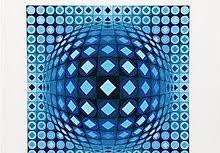
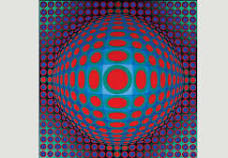
1965-: Hommage à l'hexagone, Vega: The Tribute to the hexagon
series consists of endless transformations of indentations and relief
adding color variations, creating a perpetual mobile of optical
illusion. In 1965, during the MOMA exhibition Responsive Eye dedicated
to Optical Art, the press hailed Vasarely as the inventor and creator
of Op-art. His Vega series plays with spherical swelling grids creating
an optical illusion of volume.
On 5 June 1970, Vasarely opened his first dedicated museum with
over 500 works in a renaissance palace in Gordes (closed in 1996).
A second major undertaking was the Fondation Vasarely in Aix-en-Provence,
a museum housed in a distinct structure specially designed by Vasarely.
It was inaugurated in 1976 by French president Georges Pompidou.
In that year, his large kinematic object Georges Pompidou was installed
in the Centre Pompidou in Paris and the Vasarely Museum located
at his birth place in Pécs, Hungary, was established with
a large donation of works by Vasarely. In 1982 154 specially created
serigraphs were taken into space by the cosmonaut Jean-Loup Chrétien
on board the French-Soviet spacecraft Salyut 7 and later sold for
the benefit of UNESCO. In 1987, the second Hungarian Vasarely museum
was established in Zichy Palace in Budapest with more than 400 works.
He died in Paris on 15 March 1997.
The paintings are the excellent portrayal of the events and scenes
that we see around us. The painters are the best cameras of the
world. They reproduce many different types of pictures. They even
draw imaginary pictures that do not exist in this world. We tend
to use both thinned oil paints and dense oil paints. Masterpieces
can be dyed more than once, but each time it may be different from
the existing paintings.h
|
|
|
|
|
| |
| | | | | | | | | | | | |
|
|
|