|
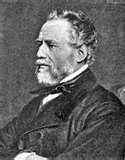
Wilhelm Marstrand
Vilhelm Nikolaj Marstrand (December 24, 1810-March
25, 1873), painter and illustrator, was born in Copenhagen, Denmark
to Nicolai Jacob Marstrand, mechanic and inventor, and Petra Ottilia
Smith. Marstrand is one of the best known artists belonging to the
Golden Age of Danish Painting.
Marstrand studied at Metropolitan School (Metropolitanskole),
but had very little interest in books, and therefore left at 16
years of age. His father, Nicolai, knew Christoffer Wilhelm Eckersberg,
painter and professor at the Royal Danish Academy of Art (Det Kongelige
Danske Kunstakademi) in Copenhagen, and according to story Eckersberg
recommended that Wilhelm attend the Academy. Vilhelm had already
shown his artistic talents, tackling difficult subject such as group
scenes with many figures and complicated composition.
At 16 years of age he began hia studies at the
Academy under Eckersberg, attending the school from 1826 to 1833.
Although Marstrand's interests had a firm hold in genre themes--
depiction of the daily life he observed around him in Copenhagen's
streets, especially middle class society-- he reached for the pinnacle
of Academic acceptability: the history painting.
History painting presented the grand themes-- classical
mythological and historical themes, not the daily life. The traditions,
and the taste of traditional art critics, favored this. It was to
be strived for, in spite of his skills at depicting the more modest
themes in daily life, and the enjoyment he had with portraying the
crowds, the diversions of city life and in revealing the humor and
story behind all the hustle and bustle.
His creative production, in the form of many painting
and illustrations made throughout the 1830s and throughout his life,
reflect this natural inclination toward showing the simple life
of his times. Christian Waagepetersen, wine merchant to the Danish
court and supporter of the arts, also became an important patron
for Marstrand during this period. His painting "A musical evening
party" (Et musikalsk aftenselskab) (1834), depicts such an
occasion at the home of Waagepetersen, and was an important transition
painting for him.
He never received the big gold medallion from the
Academy. This medallion was not only coveted for the honour and
recognition it bestowed, but also because it included a travel stipend
for furthering the artist's training. His attempts at procuring
the medallion lost both in 1833 with his neoclassical "Flight
to Egypt" (Flugten til Ægypten) and in 1835 with "Odysseus
and Nausikaa". This was a disappointment as he had won both
silver medals in 1833.
In spite of his not receiving the medallion, the
Academy awarded him a travel stipend from its general fund. In August
1836 he began his travels, going by way of Germany to Rome, Italy,
stopping on the way at Berlin, Dresden, Nuremberg and Munich. In
Italy, where he stayed for four years, he painted many idealized
depictions of daily life, especially festivities. He was very much
taken by Italy and the life styles of the Italian people. He portrayed
a colorful and joyous view of them, infused with a new found ideal
of beauty.
He also painted a few portraits during this first
stay in Italy. Among these are portraits of other travelling Danish
artists, such as Christen Købke and travelling partner Johan
Adolph Kittendorff. He also completed sketches for a large portrait
of botanist and politician, J.F. Schouw, which would be later realized
as a painting.
He returned to Denmark at the end of 1841, stopping
in Munich and Paris along the way. In Denmark he tried to bring
back that which he learned in Italy, and let it develop in his home
culture.
He became a member of the Academy June 19, 1843,
after having submitted the painting "Erasmus Montanus"
as his admissions piece. He became a professor at the Academy in
1848. He strived to let his students develop after their own skills
and interests, among these being Peder Severin Krøyer, Michael
Ancher, Carl Bloch and Kristian Zahrtmann.
He continued to travel regularly throughout Europe
throughout his life, to (London, Vienna (1853-1854), Belgium, but
especially to Italy and Rome), sometimes in the company of fellow
artists N.L. Høyen (also art historian and critic), P.C.
Skovgaard and Johan Adolph Kittendorff.
He continued to draw inspiration from Italy in
his paintings. He drew also inspiration from literature and the
theatre, portraying scenes from Don Quixote by Cervantes, as well
as from Erasmus Montanus, a play by Danish poet and playwright Ludvig
Holberg. Holberg's works would provide Marstrand with much inspiration.
And he continued to paint genre paintings, and
to make sketches, caricatures and drawings that capture the spirit
of that time with sharp satire. Marstrand married Margrethe Christine
Weidemann on June 8, 1850 with whom he had five children. His family
became also a source for his painting. One can see certain similarities
in his portraits of the children to those made by Constantin Hansen,
one of his contemporaries, and another student of Eckersberg.
He began painting portaits seriously again in the
late 1850s, depicting some of the most important figures of the
time, including artist Constantin Hansen (1852, 1862), Grundtvig
(1863), N.L. Høyen (1869), Gottlieb Bindesbøll, and
his earlier portraiture of Christen Købke 1839.
During the 1850s and 1860s he began to paint religious
themes, especially after the death of his wife in 1867. He focused
also again on paintings with mythological and historical themes.
He painted mural decoration for King Christian IV's chapel in Roskilde
Cathedral (Domkirke) between 1864-1866. These featured scenes from
the life of the monarch. He painted a large alterpiece at Faaborg
Church. In 1871, shortly before his death, he delivered large wallpaintings
made for the University of Copenhagen's Celebration Hall (Festsal).
These are considered some of his best historical paintings.
He was named Director of the Academy during two
periods: the first period was from 1853-1857, the other period was
from 1863 until his death in 1873. He was named State Councillor
(etatsråd) in 1867.
During the last ten years of this life his works
became very intimate. A series of paintings made during the last
6 years of his life featured a naked woman, while others are deeply
religious.
In October 1871 he was struck with a brain hemorrhage.
Marstrand, in his lifetime, was proclaimed one
of the greatest Danish artists ever. He was extremely productive,
and mastered a number of genres. He was best known for the scenes
of daily life in Copenhagen that he painted in his younger days,
for the Italian festivities he portrayed, and from 1830 on the many
portraits of Copenhagen's middle class and influential, and the
larger commissioned pieces for the University and the monarchy.
After his death his work became less valued due to the fact that
its style was deemed unfashionable, but there has been renewed appreciation
for his work.
The paintings are the excellent portrayal of the events and scenes
that we see around us. The painters are the best cameras of the
world. They reproduce many different types of pictures. They even
draw imaginary pictures that do not exist in this world. We tend
to use both thinned oil paints and dense oil paints. Masterpieces
can be dyed more than once, but each time it may be different from
the existing paintings.h
|
|
|
|
|
| |
| | | | | | | | | | | | |
|