William Blake

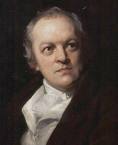
William Blake (November 28, 1757 – August 12, 1827) was an English poet, painter and printmaker, or "Author & Printer", as he signed many of his books. He is now widely recognised as a genius of English letters, and one of the foremost (arguably the foremost) visionary artists of the modern age; it is now fashionable in certain circles to criticise his art as simplistic. It is likely fair to state that Blake's visual art, if only for being so closely wedded to his verse, will outlive such criticism.

Early career


Blake was born at 28 Broad Street, Golden Square, London into a middle-class family. He was from earliest youth a seer of visions and a dreamer of dreams, seeing "Ezekiel sitting under a green bough", and "a tree full of angels at Peckham", and such he remained to the end of his days. His teeming imagination sought expression both in verse and in drawing. At ten years old, he began engraving copies of drawings of Greek antiquities, a practice that was then preferred to real-life drawing. Four years later he became apprenticed to an engraver, James Basire. After two years Basire sent him to copy art from the Gothic churches in London. At the age of twenty-one Blake finished his apprenticeship and set up as a professional engraver.

In 1779, he became a student at the Royal Academy, where he rebelled against what he regarded as the unfinished style of fashionable painters such as Rubens. He preferred the Classical exactness of Michelangelo and Raphael.

In July, 1780, he was at the head of a rampaging mob that stormed Newgate Prison in London. The mob were wearing blue cockades (ribbons) on their caps, to symbolise solidarity with the insurrection in the American colonies. This disturbance, later known as the Gordon riots, provoked a flurry of paranoid legislation from the government of George III, as well as the creation of the first police force.

In 1782 Blake met John Flaxman, who was to become his patron. In the same year he married a poor, illiterate girl named Catherine Boucher, who was five years his junior. Catherine signed her wedding contract with an X. Blake taught her to read and write and even trained her as an engraver. At that time, George Cumberland, one of the founders of the National Gallery, became an admirer of Blake's work.


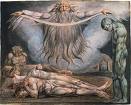
Illustration: The archetype of the Creator is a familiar image in the illuminated books of William Blake. Here, Blake depicts an almighty creator stooped in prayer contemplating the world he has forged. The Song of Los is the third in a series of illuminated books, hand painted by Blake and his wife, known as the "Continental Prophecies", considered by critics to contain some of Blake's most powerful imagery.Blake's first collection of poems, Poetical Sketches, was published circa 1783. After his fathers death, William and brother Robert opened a print shop in 1784 and began working with radical publisher Joseph Johnson. At Johnson's house he met some of the leading intellectual dissidents of the time in England, including Joseph Priestley, scientist; Richard Price, philosopher; John Henry Fuseli, painter whom he became friends with; Mary Wollstonecraft, feminist; and Thomas Paine, American revolutionary. Along with William Wordsworth and William Godwin, Blake had great hopes for the American and French revolution and wore a red liberty cap in solidarity with the French revolutionaries, but despaired with the rise of Robespierre and the Reign of Terror in the French revolution.

Mary Wollstonecraft became a close friend, and Blake illustrated her Original Stories from Real Life (1788). They shared similar views on sexual equality and the institution of marriage. In the Visions of the Daughters of Albion in 1793 Blake condemned the cruel absurdity of enforced chastity and marriage without love and defended the right of women to complete self-fulfillment.


In 1788, at the age of thirty-one, Blake began to experiment with relief etching, which was the method used to produce most of his books of poems. Blake wrote in a letter that the method was revealed to him in a dream, by his dead brother, Robert. The process is also referred to as illuminated printing, and final products as illuminated books or prints. Illuminated printing involved writing the text of the poems on copper plates with pens and brushes, using an acid-resistant medium. Illustrations could appear alongside words in the manner of earlier illuminated manuscripts. He then etched the plates in acid in order to dissolve away the untreated copper and leave the design standing. The pages printed from these plates then had to be hand-colored in water colors and stitched together to make up a volume. Blake used illuminated printing for four of his works: the Songs of Innocence and Experience, The Book of Thel, The Marriage of Heaven and Hell, and Jerusalem. Each of his illuminated books was thus a unique work of art and a radical break with not only traditional book printing but the traditional means of presenting poetic and philosophical discourse. Blake seems to have believed, or rather hoped, that self published books could liberate the artist and author from the tyranny of censorship by Church and State but its time consuming nature meant that his most personal and prophetic works reached a minute audience in his lifetime.


The paintings are the excellent portrayal of the events and scenes that we see around us. The painters are the best cameras of the world. They reproduce many different types of pictures. They even draw imaginary pictures that do not exist in this world. We tend to use both thinned oil paints and dense oil paints. Masterpieces can be dyed more than once, but each time it may be different from the existing paintings.h

Sitemap
Painter sitemap
Techniques sitemap
Materials sitemap


famous paintings | famous painters | painting styles | famous artists | mixed media painting | painting technique | oil paintings | canvas painting | life oil painting still | abstract art paintings | modern art work | fine art painting landscape | oil painting reproductions - media | history of paintings | oil painting - idioms | links | review painting articles | review painting news | press release | Kids Costumes | Women costumes