Oil painting -> List of Painters -> William Michael Harnett

Personal Details
Name |
William Michael Harnett |
Place of birth |
Clonakilty, County Cork, Ireland |
Date of Birth |
August 10, 1848 |
Date of Death |
October 29, 1892 |
Nationality |
Irish-American |
Field |
Painter |
Popular Paintings |
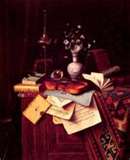
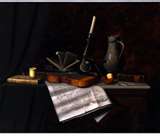
A study table, Still life violin and music, Der treue Colt |
Museum |
Albright-Knox Art Gallery, Amon Carter Museum |
William Harnett (1848-1892) was an American painter best known for his trompe l'oeil still lifes of ordinary objects. Born in Philadelphia, Pennsylvania, Harnett began his career as a house painter and apprenticed with a sign painter. He also studied at the Pennsylvania Academy of the Fine Arts and the Cooper Union in New York City.
Harnett's early works were painted in an academic style, but he soon shifted to a more realistic approach. He began to paint still lifes of everyday objects, such as coins, books, and musical instruments, in a trompe l'oeil style. He was greatly influenced by the works of Dutch painter Johannes Vermeer, as well as by the realism of the Spanish master Diego Vel?zquez.
Harnett's works are characterized by their meticulous detail and accurate representation. He often used a dark background to create a greater sense of depth, and he often portrayed objects with a slightly distorted perspective, which gave them a more realistic feel. He also used light and shadow to create a more dramatic effect.
Harnett's works often featured themes of mortality, with objects such as skulls, candles, and hourglasses symbolizing the passing of time. He also used his paintings to comment on the plight of the working class, as in his 1882 painting After The Hunt, which shows a dog, a shotgun, and a dead rabbit alluding to the death and destruction of the Industrial Revolution.
Harnett traveled widely and spent much of his later years in Europe. He had a strong influence on many American painters, such as John Haberle and William Merritt Chase, and his works are held in many major art galleries around the world. He died in 1892 in New York City at the age of 44.
Works Of William Michael Harnett:
|
|
|