Allegory
An allegory (from Greek a, allos, "other", and agoreuein, "to speak in public") is a figurative mode of representation conveying a meaning other than and in addition to the literal.Through allegory a subject of a higher spiritual order is described in terms of that of a lower which is made out to resemble it in properties and circumstances, the principal subject being so kept out of view that we are left to construe the drift of it from the resemblance of the secondary to the primary subject.
Allegory is generally treated as a figure of rhetoric, but an allegory does not have to be expressed in language: it may be addressed to the eye, and is often found in painting, sculpture or some form of mimetic art. The etymological meaning of the word is wider than that which it bears in actual use. Though it is similar to other rhetorical comparisons, an allegory is sustained longer and more full in its details than a metaphor, and appeals to imagination where an analogy appeals to reason. The fable or parable is a short allegory with one definite moral.
Northrop Frye discussed the continuum of allegory from what he termed the "naive allegory" of The Faerie Queen to the more private allegories of modern paradox literature. The characters in a "naive" allegory are not fully three dimensional, for each aspect of their individual personalities and the events that befall them embodies some moral quality or other abstraction. The allegory has been selected first: the details merely flesh it out. Since meaningful stories are always applicable to larger issues, allegories may be read into many significant stories, sometimes distorting their author's overt meaning. J.R.R. Tolkien's distaste for allegory is famous.
The allegory has been a favourite form in the literature of nearly every nation. The Hebrew scriptures present frequent instances of it, one of the most beautiful being the comparison of the history of Israel to the growth of a vine in Psalm 80:19-17. In the Rabbinic tradition fully-developed allegorical readings were applied to every text, with every detail of the narrative given an emblematic reading, a tradition that was inherited by Christian writers, for whom allegorical similitudes are the basis of exegesis, the origin of the arts of hermeneutics. The late Jewish and Early Christian visionary Apocalyptic literature, with its base in the Book of Daniel, presents allegorical figures, of which the Whore of Babylon and the Beast of Revelation are simply the most familiar.
In classical literature two of the best known allegories are the cave of shadowy representations in Plato's Republic (Book VII) and the story of the stomach and its members in the speech of Menenius Agrippa (Livy ii. 32); and several occur in Ovid's Metamorphoses. In Late Antiquity Martianus Capella organized all the information a 5th-century upper-class male needed to know into an allegory of the wedding of Mercury and Philologia, with the seven liberal arts as guests, an allegory that was widely read through the Middle Ages. In the late 15th century, the enigmatic Hypnerotomachia, with its elaborate woodcut illustrations, shows the influence of themed pageants and masques on contemporary allegorical representation. Some elaborate and successful specimens of allegory are to be found in the following works, arranged in approximately chronological order:
Aesop – Fables
Plato – The Republic (Allegory of the Cave)
Plato – Phaedrus (Chariot Allegory)
Book of Revelation
Martianus Capella – De nuptiis philologiæ et Mercurii
The Romance of the Rose
Piers Plowman
The Pearl
Dante Alighieri – The Divine Comedy
Edmund Spenser – The Faerie Queene
John Bunyan – Pilgrim's Progress
Jean de La Fontaine – Fables
Jonathan Swift – A Tale of a Tub
Joseph Addison – Vision of Mirza
Modern allegories in fiction include:
William Golding – Lord of the Flies
George Orwell – Animal Farm
Arthur Miller – The Crucible
Philip Pullman – His Dark Materials
Hualing Nieh: Mulberry and Peach Allegorical films include:
Fritz Lang's Metropolis
Ingmar Bergman's The Seventh Seal
El Topo etc.
Allegorical artworks include:
Sandro Botticelli – La Primavera (Allegory of Spring)
Albrecht Dürer – Melancholia I
Artemisia Gentileschi – Self-Portrait as the Allegory of Painting;
Allegory of Inclination
Jan Vermeer – The Allegory of Painting
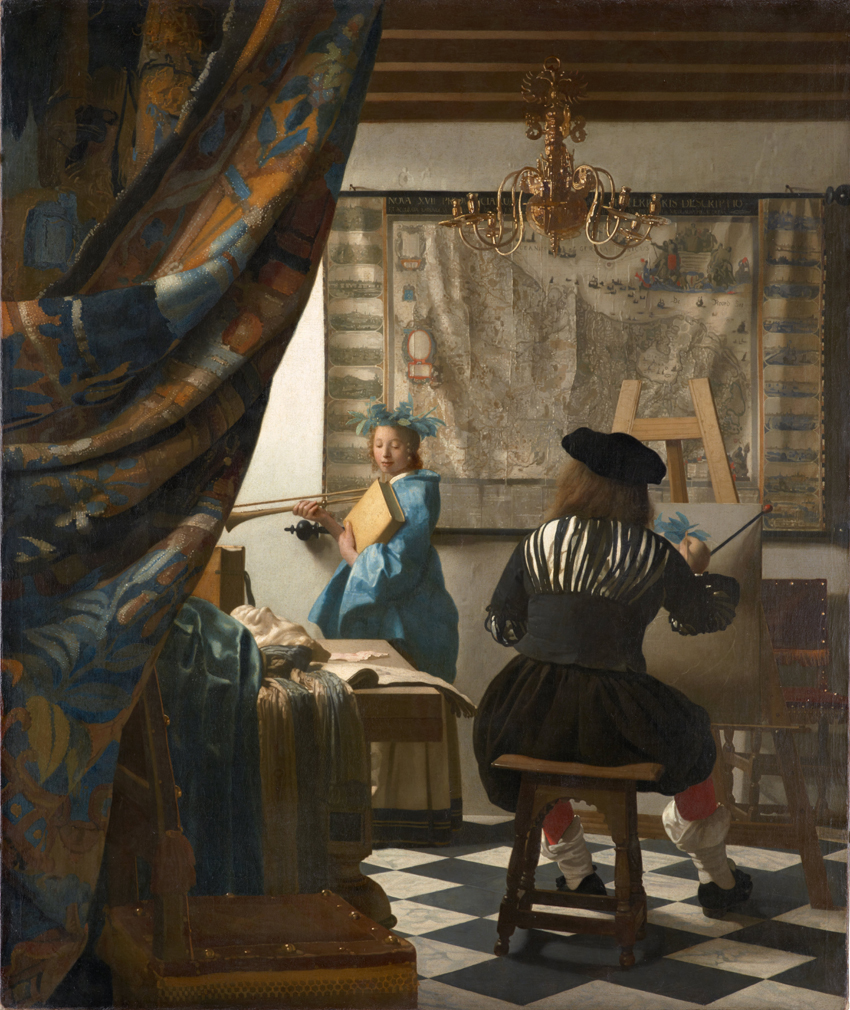
Jan Vermeer,?The Art of Painting
-allegory-big.jpg)
Writers or speakers typically use allegories as literary devices or as rhetorical devices that convey hidden meanings through symbolic figures, actions, imagery, or events, which together create the moral, spiritual, or political meaning the author wishes to convey.