A camera lucida is an optical device used as a drawing aid by artists. It was patented in 1806 by William Hyde Wollaston. There seems to be evidence that the camera lucida was actually nothing but a reinvention of a device clearly descibed 200 years earlier by Johannes Kepler in his Dioprice (1611). By the 19th century, Kepler’ description had totally fallen into oblivion, so that nobody challenged Wollaston’s claim. The term "camera lucida" is Wollaston‘s. (cf. Edmund Hoppe, Geschichte der Optik, Leipzig 1926).
The camera lucida performs an optical superimposition of the subject being viewed and the surface on which the artist is drawing. The artist sees both scene and drawing surface simultaneously, as in a photographic double exposure. This allows the artist to transfer key points from the scene to the drawing surface, thus aiding in the accurate rendering of perspective. The artist can even trace the outlines of objects in the scene.
1807 engraving of camera lucida in use.If white paper is used, the
superimposition of the paper with the scene tends to wash out the
scene, making it difficult to view. When working with a camera lucida
it is beneficial to use black paper and to draw with a white pencil.
The camera lucida is still available today through art-supply channels, but is not well-known or widely used. As recently as a few decades ago it was, however, still a standard tool of microscopists. Until very recently, photomicrographs were expensive to reproduce. Furthermore, in many cases, a clear illustration of the structure that the microscopist wished to document was much easier to produce by drawing than by micrography. Thus, most routine histological and microanatomical illustrations in textbooks and research papers were camera lucida drawings rather than photomicrographs.
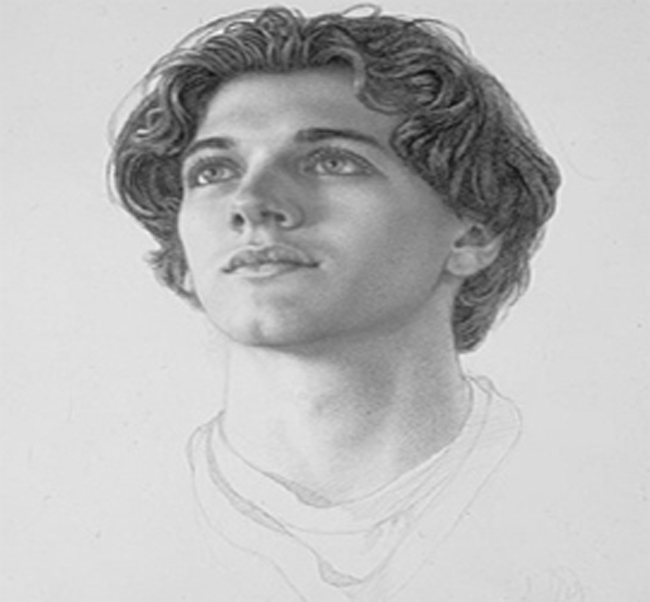
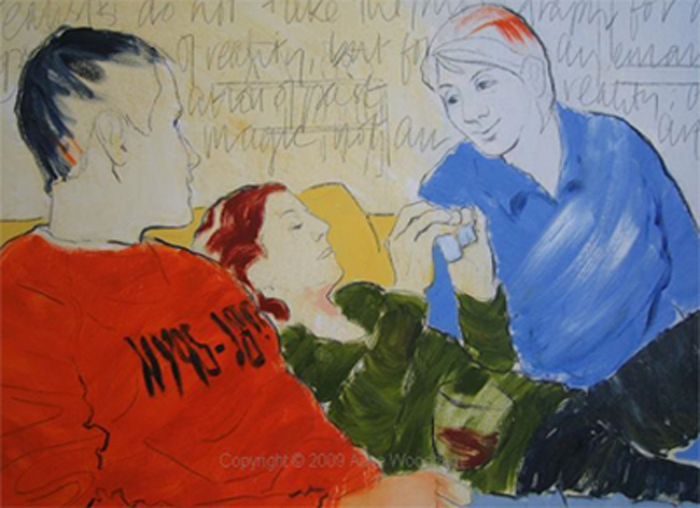


The name "camera lucida" (Latin for "lit room") is obviously intended to recall the much older drawing aid, the camera obscura (Latin for "dark room"). There is no optical similarity between the devices. The camera lucida is a light, portable device that does not require special lighting conditions. No image is projected by the camera lucida.
In the simplest form of camera lucida, the artist looks down at the drawing surface through a half-silvered mirror tilted at 45 degrees. This superimposes a direct view of the drawing surface beneath, and a reflected view of a scene horizontally in front of the artist. The instrument often includes a weak negative lens, creating a virtual image of the scene at about the same distance as the drawing surface, so that both can be viewed in good focus simultaneously.
While on honeymoon in Italy in 1833, the photographic pioneer William Fox Talbot used a camera lucida as a sketching aid. He later recorded that it was disappointment with his resulting efforts which encoraged him to seek a means to "cause these natural images to imprint themselves durably".