Oil Painting ->Chiaroscuro
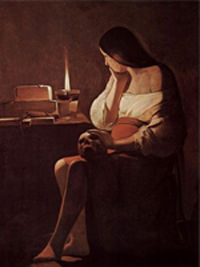
An element in art, chiaroscuro (Italian for lightdark) is defined as a bold contrast between light and dark.
A certain amount of chiaroscuro is the effect of light modelling in painting, where three-dimensional volume is suggested by highlights and shadow, fully developed in 15th century painting in Italy and Flanders. But true chiaroscuro is developed during the 16th century, in Mannerism and in Baroque art. Dark subjects dramatically lighted by a shaft of light from a single constricted and often unseen source was a compositional device developed by Ugo da Carpi (c.1455-c.1523) and Michelangelo Merisi da Caravaggio (1573-1610).
The term chiaroscuro has been applied since the later 18th century to a printmaking technique which finds its best expressions in aquatint and in xylography, and in china (ink) drawing. The technique requires a skilled knowledge of the perspective, the physical effects of light on surfaces, the shadows. Chiaroscuro defines objects without a contouring line, but only by the contrast between the colours of the object and of the background.
Despite a frequent confusion, chiaroscuro technique in printmaking is different from German camaieu, in which the graphical effect is prevalent on the plastic effect (obtained with chiaroscuro to recall basrelief and painting "feeling"), and which more often uses coloured paper.