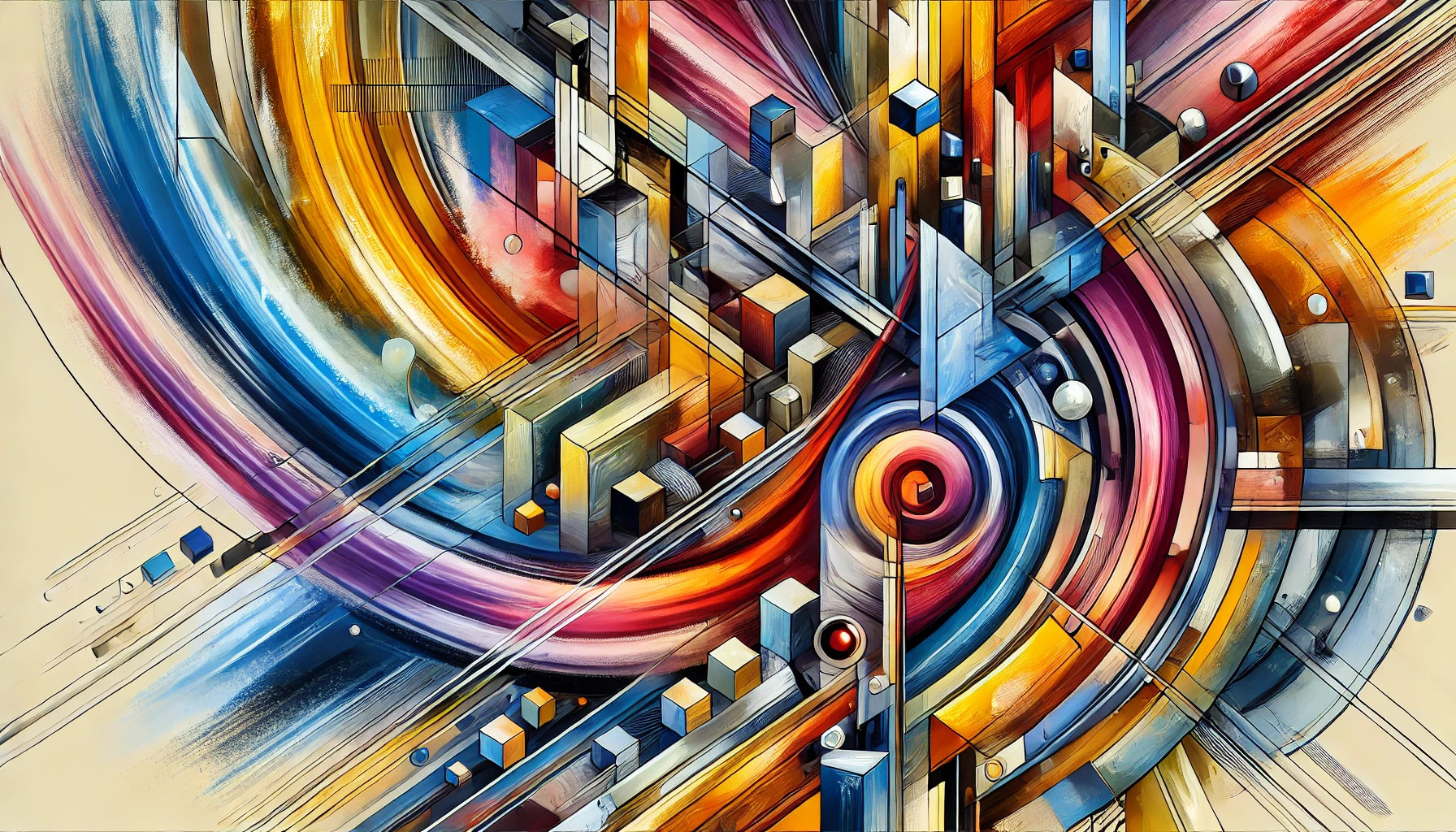
Cubism was an avant-garde art movement that revolutionized European painting and sculpture in the early 20th century.
In cubist artworks objects are broken up, analyzed, and reassembled in an abstracted form — instead of rendering objects from a single fixed angle, the artist divides them into multiple facets, so several different aspects, or faces, of the objects are seen simultaneously. Often the surfaces of the facets, or planes, intersect at angles that show no recognizable depth.
Cubism began in 1906 with Georges Braque and Pablo Picasso, who lived in the Montmartre quarter of Paris, France. They met in 1907, and worked closely together until World War I began in 1914.
French art critic Louis Vauxcelles first used the term "cubism" "(bizarre cubiques)" in 1908. After which, the term was in wide use but the two creators of cubism refrained from using it for a quite some time.
The cubism movement, born in Montmartre, expanded by the gathering of artists in Montparnasse, and was promoted by art dealer Henry Kahnweiler. It became popular so quickly that by 1910 critics were referring to a "cubist school" of artists influenced by Braque and Picasso. However, many other artists who thought of themselves as cubists went in directions quite different from Braque and Picasso, who themselves went through several distinct phases before 1920. Famous became the Puteaux Group, an offshoot of the Cubist movement, to which artists like Guillaume Apollinaire, Robert Delaunay, Marcel Duchamp, Fernand Léger belonged.
Cubism influenced artists of the first decades of the 20th century and it gave rise to development of new trends in art like futurism, constructivism and expressionism.
Violon, verre, pipe et encrier by Pablo Picasso, 1912.Innovative artists, Braque and Picasso sought new ways to express space and form in painting. They were influenced by Paul Cezanne, Georges Seurat, Iberian sculpture, African tribal art (although Braque later disputed this), and by the Fauves.
Picasso and Braque worked alongside one another (1906-1909 pre-cubism) and then started to work hand-in-hand to further advance their concepts into what was later termed "analytical cubism" (autumn 1909 to winter 1911/1912), a style in which densely patterned near-monochrome surfaces of incomplete directional lines and modelled forms constantly play against one another.
Picasso's painting of the Les Demoiselles d'Avignon is not considered cubist, however it is considered essential in the development of the movement. In this work Picasso first experiments with seeing the same object, or figure in this case, from various directions. Impressed by the painting, Braque experimented further with this idea. The developments of both men in the field would lead to what would be cubism.
Some art historians have also identified a secondary phase in this analytical period, the "Hermetic" phase, in which the works are characterized by being monochromatic and hard to decipher. The painters gave clues as to what is portrayed by leaving some identifiable object. For example a pipe, which leads to identifying that a person is smoking it. During this time the cubists neared abstraction. Some alphabetic letters were introduced to the works during this phase, to also serve as clues. Braque introduced these which gave immediate connection to everyday objects like a bottle of rum or a newspaper.
The second phase of cubism, beginning in 1912, is called "synthetic cubism".
These works of art are composed of distinct superimposed parts — painted or often pasted onto the canvas — and are characterized by brighter colours, something that they had previously tried to reintroduce, but were unsuccesful in doing so in a smooth transitory way. Unlike analytic cubism, which fragmented objects into its composing parts or facets, synthetic cubism attempted more to bring many different objects together to create new forms.
This phase constitutes the birth of the collage and of papier collé. Picasso invented the collage with his Still Life with Chair Caning, in which he pasted a patch of oil cloth painted with a chair-caning design to the canvass of the piece. Braque, interested by Picasso's technique, first employed papier collé in his piece Fruitdish and Glass. Papier collé consists of pasting material to a work much in the same way as a collage, except the shape of the patches are objects themselves. For example, the glass on the left in Fruitdish and Glass is a piece of newspaper cut into the shape of a glass.
While Braque had previously used lettering, the two artist's synthetic pieces began to take the idea to a new extreme. Letters that had hinted to the objects, became objects themselves. Newspaper scraps are among the most usual items the artists pasted to their canvases. They went further by adding paper with a wood print, or other types of scraps. Later they pasted advertisements, as well. This helped reintroduce color into the cubist works.
Georges Braque
Marcel Duchamp
Juan Gris
Fernand Leger
Jacques Lipchitz
Louis Marcoussis
Marie Marevna Vorobyev-Stebelska (for a specimen of her cubist paintings
depicting herself, her daughter Marika and Marika's father Diego
Rivera – himself a "master cubist" – with
friends from La Ruche, cf. this Korean website where it is the 16th
painting in sequence;)
Jean Metzinger
Francis Picabia
Pablo Picasso
Liubov Popova
Marie Vassilieff
Fritz Wotruba
There were also critics (Andre Salamon, Guillaume Apollinaire),
poets (Max Jacob, Pierre Reverdy, Gertrude Stein) and following
Jacques Lipchitz, other sculptors such as Raymond Duchamp-Villon
and Elie Nadelman who were soon drawn into the sphere of cubism.
Robert Delaunay practiced what he called "Orphic cubism" which is identified with the Puteaux Group.
Pigeons have been trained to correctly distinguish between cubist and impressionist paintings.