Oil Painting » Painting Supports » Panel Painting
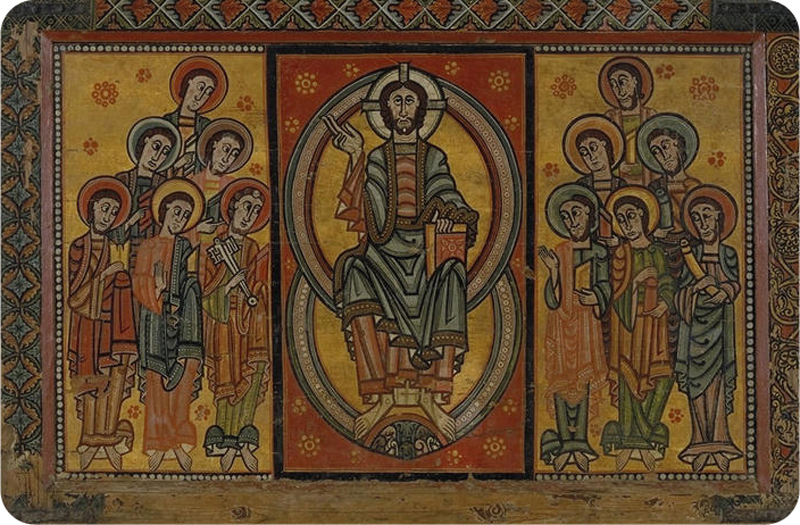

A Panel painting was a painting support medium in popular use in the West for about 300 years, from the late 12th century until the 16th century, after which canvas and oil paint became the norm. A "panel" was created from wood with a chalk mixture layered on top to form a solid, smooth surface, not unlike ivory, and was then painted using an egg-yolk based paint. A panel painting would typically be displayed inside a church as an altarpiece, or behind or in front of the altar as a visual enhancement to a sermon while in later years it would be integrated into furniture. Along with fresco it was the primary medium of Gothic painting.
Panel painting is very old; we know it existed in Greece and Rome, but very few have survived. It was also important in Byzantine art but again, few have survived due to the iconoclasm of the 9th century.
In the late 12th century panel painting experienced a revival in Western Europe because of new liturgical practices the priest and congregation were now on the same side of the altar, leaving the space behind the altar free for the display of a holy image—and thus altar decorations were in demand. The earliest forms of panel painting were dossals (altar backs), altar fronts and crucifixes. All were painted with religious images, commonly the Virgin and Child, Christ, Saints.
Italy in the 13th and 14th centuries was the golden age of panel painting. However, it is estimated that of all the panel paintings produced there, 99.9 percent have been lost.
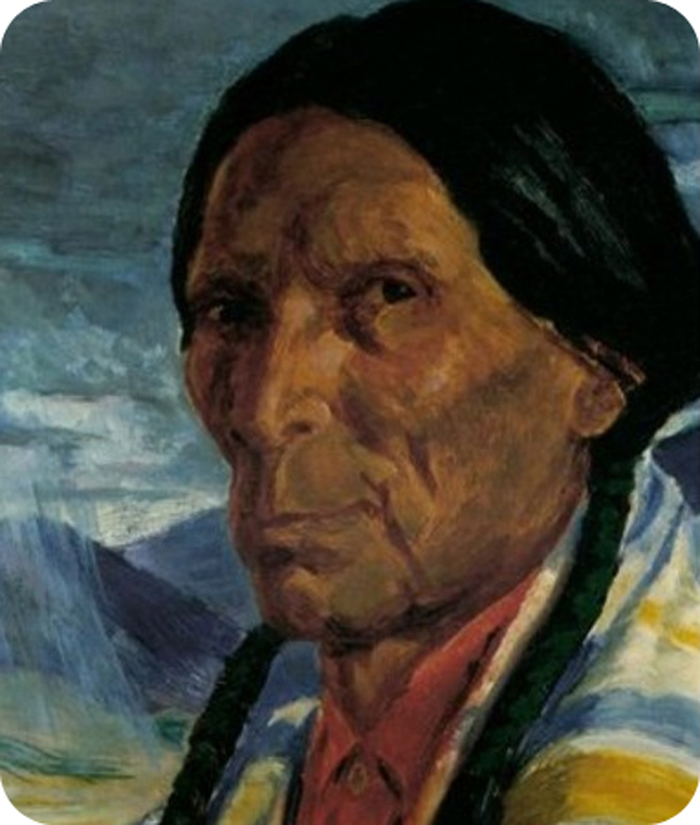
By the 15th century with the appearance of humanism, and a changing attitude about the function of art and patronage, panel painting went in new directions. Secular art opened the way to the creation of chests, painted beds, birth trays and other furniture. The awareness of the importance of the individual gave rise to a new form: the portrait.
While popular throughout Western Europe, Italy was where panel painting flourished. Italians developed a technique for the construction that lasted unchanged for over 300 years, until the introduction of oil paint in the 15th century and the use of canvas in the 16th century became the norm. The technique is known to us through Cennino Cennini's The Craftsman's Handbook (Il libro dell' arte) published in 1390. It was a laborious and painstaking process:
A carpenter would construct a solid wood piece the size of the
panel needed. It was usually seasoned poplar, willow or linden.
It would be planed and sanded and if needed, joined with other pieces
to obtain the desired size and shape.
The wood would be coated with a mixture of animal-skin glues and
resin and covered with linen (the mixture and linen combination
was known as a size).
Once the size had dried, layer upon layer of gesso would be applied,
each layer sanded down before the next applied, sometimes as many
as 15 layers, before a smooth hard surface emerged, not unlike ivory.
Once the panel construction was complete, the design was laid out
in charcoal, making corrections and adjustments, until it reached
the artists vision. Then using small brushes dipped in a mixture
of pigment and egg-yolk (known as tempera), the paint was applied
in very small strokes. Because tempera dries quickly and is not
conducive to mistakes, each stroke was a one-shot chance and had
to be perfect each time. This exacting perfection shaped the nature
and style of the art produced.