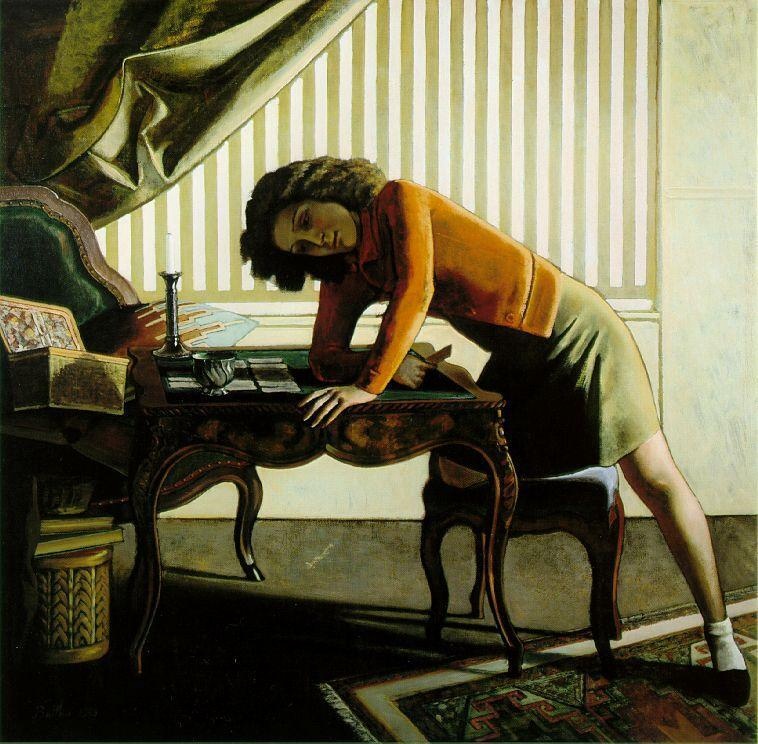
Balthus

Balthazar Klossowski de Rola (February 29, 1908 in Paris – February 18, 2001) was an esteemed Polish/French modern artist whose work was ultimately anti-modern.

Life and Work

In his formative years his art was sponsored by Rainer Maria Rilke, Pierre Bonnard and Henri Matisse. His father, Erich Klossowski, a noted art historian (he wrote a monograph on Daumier), and his mother Elisabeth Dorothea Spiro (known as Baladine Klossowska) were part of cultural elite in Paris. Balthus' older brother, Pierre Klossowski, was a philosopher influenced by Marquis de Sade writings. Jean Cocteau, who was friend of the Klossowskis, found some inspiration for his novel Les Enfants Terribles (1929) on his visits to the family.
As he matured in the early 1930s, Balthus' paintings often depicted pubescent young girls in erotic and voyeuristic poses. One of his most notorious works was The Guitar Lesson (1934), which caused controversy in Paris due to its depiction of a sexually explicit lesbian scene featuring a young girl and her teacher.

In 1937 he married Antoinette de Watteville, whom he met as early as in 1924. She was the model for a series of portraits.

Early on his work was admired by writers and fellow painters, especially by André Breton and Pablo Picasso. His circle of friends in Paris included the novelist Pierre-Jean Jouve, the photographers Josef Breitenbach and Man Ray, Antonin Artaud, and the painters André Derain, Joan Miro and Alberto Giacometti (one of the most faithful of his friends). In 1948, another friend, Albert Camus, asked him to design the sets and costumes for his play L'Etat de Siège (The State of Siege, directed by Jean-Louis Barrault).

Balthus spent most of his life in France, and as international fame grew he cultivated himself and his past as an enigma. In 1953 he moved into the Chateau de Chassy, were he finished his masterpieces 'The Room' (1952, influenced by Pierre Klossowski's novels) and 'The Street' (1954). In 1964 he moved to Rome, were he presided over Villa de Medici director of the French Academy in Rome, and made friends with the filmmaker Frederico Fellini and the painter Renato Guttuso.

In 1977 he moved to Rossinière, Switzerland. That he had a second, Japanese wife Setsuko thirty-five years his junior simply added to the air of mystery around him (he met her in Japan, during a diplomatic mission initiated by André Malraux). The photographers and friends Henri Cartier-Bresson and Martine Franck (Cartier-Bresson's wife), both portrayed the painter and his wife and their daughter Harumi in his Grand Chalet in Rossinière in 1999.

Balthus was the only living artist who had his artwork in the Louvre's collection (it came from Picasso's private collection when it was donated to that museum).

Prime Ministers and rock stars alike attended the funeral of Balthus. Bono, lead-singer of U2, sang for the hundreds of mourners at the funeral. Biographers rushed into print shortly after his death, and their work has since been severely and widely criticised as being unreasonable and confused.

Influence and legacy

The work of Balthus shows numerous influences, including Masaccio, Piero della Francesca, Poussin, Jean-Étienne Liotard, Joseph Reinhardt, Géricault, Ingres, Goya, Courbet, Felix Vallotton and Paul Cezanne. His favourite composer was Wolfgang Amadeus Mozart (he designed the stage for one of the composer's operas, Così fan tutte, in Aix-en-Provence, together with Adolphe Mouron Cassandre).

His work influenced several artists, among them the filmmaker Jacques Rivette of the French New Wave. His film Hurlevent (1985) was inspired by Balthus' drawings made at the beginning of the 1930s. As his says in an interview with Valerie Hazette: "Seeing as he's a bit of an eccentric and all that, I am very fond of Balthus (...) I was struck by the fact that Balthus enormously simplified the costumes and stripped away the imagery trappings (...)".

Another artist influenced by Balthus is the photographer Duane Michals.

The novel Hannibal by Thomas Harris refers to the fictional Hannibal Lecter as a cousin of Balthus.


The paintings are the excellent portrayal of the events and scenes that we see around us. The painters are the best cameras of the world. They reproduce many different types of pictures. They even draw imaginary pictures that do not exist in this world. We tend to use both thinned oil paints and dense oil paints. Masterpieces can be dyed more than once, but each time it may be different from the existing paintings.h

Sitemap
Painter sitemap
Techniques sitemap
Materials sitemap


famous paintings | famous painters | painting styles | famous artists | mixed media painting | painting technique | oil paintings | canvas painting | life oil painting still | abstract art paintings | modern art work | fine art painting landscape | oil painting reproductions - media | history of paintings | oil painting - idioms | links | review painting articles | review painting news | press release | Kids Costumes | Women costumes