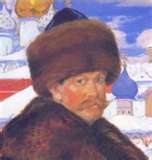
Boris Kustodiev

Boris Mikhailovich Kustodiev ( March 7, 1878 - May 28, 1927) was Russian art deco painter.

Biography

Boris Mikhailovich Kustodiev was born in Astrakhan on March 7, 1878 into the family of a professor of philosophy, history of literature, and logic at the local theological seminary. His father died young, and all financial and material burdens lay on his mother's shoulders. The Kustodiev family rented a small wing in a rich merchant's house. It was here that the boy's first impressions were formed of the way of life of the provincial merchant class. The artist later wrote, 'The whole tenor of the rich and plentiful merchant way of life was there right under my nose ... It was like something out of an Ostrovsky play.' The artist retained these childhood observations for years, recreating them later in oils and water-colours.

Between 1893 and 1896, Boris studied in theological seminary and took private art lessons in Astrakhan from Pavel Vlasov, a pupil of Vasily Perov. Subsequently, from 1896 to 1903, he attended Ilya Repin’s studio at the Imperial Academy of Arts in Saint Petersburg. Concurrently he took classes in sculpture under Dmitry Stelletsky and in etching under Vasily Mathé. He first exhibited in 1896.

'I have great hopes for Kustodiev,' wrote Repin. 'He is a talented artist and a thoughtful and serious man with a deep love of art; he is making a careful study of nature ...' When Repin was commissioned to paint a large-scale canvas to commemorate the 100th anniversary of the State Council, he invited Kustodiev to be his assistant. The work was extremely complex and involved a great deal of hard work. Together with his teacher, the young artist made portrait studies tor the painting, and then executed the right-hand side of the final work. At this time too, Kustodiev made a series of portraits of contemporaries whom he felt to be his spiritual comrades. These included the artist Ivan Bilibin (1901, Russian Museum), Moldovtsev (1901, Krasnodar Regional Art Museum) and the engraver Mathé (1902, Russian Museum). Working on these portraits considerably helped the artist, forcing him to make a close study of his model and to penetrate the complex world of the human soul.

In 1903 he married Julia Proshinskaja (1880-1942).

He visited France and Spain on a grant from the Imperial Academy of Arts in 1904. In 1904, he attended the private studio of René Ménard in Paris. In 1904, he traveled to Spain, in 1907 to Italy, and in 1909 visited Austria, France, and Germany, and again Italy. During these years he painted many portraits and genre pieces. However, no matter where Kustodiev happened to be—in sunny Seville or in the park at Versailles—he felt the irresistible pull of his motherland. After five months in France he returned to Russia. Joyfully he wrote to his friend Mathé that he was back once more 'in our blessed Russian land'.

The Russian Revolution of 1905, which shook the foundations of society, evoked a vivid response in the artist's soul. He contributed to the satirical journals Zhupel (Bugbear) and Adskaya Pochta (Hell’s Mail). At that time, he first met the World of Art (Russian: Mir Iskusstva) artists, a group of innovative Russian artists. He joined their association in 1910 and subsequently took part in all their exhibitions.

In 1905 Kustodiev first turned to book illustrating, a genre in which he worked throughout his entire life. He illustrated many works of classical Russian literature, including Gogol's Dead Soul, The Carriage and The Overcoat, Lermontov's The Lay of Tsar Ivan Vassilyevich, His Young Oprichnik and the Stouthearted Merchant Kalashnikov and Lev Tolstoy's How the Devil Stole the Peasants Hunk of Bread and The Candle.

In 1909, he was elected into Imperial Academy of Arts.

He continued to work intensively, but a grave illness — tuberculosis of the spine — required urgent attention. On the advice of his doctors he went to Switzerland, where he spent a year undergoing treatment in a private clinic. He pined for his distant homeland, and Russian themes continued to provide the basic material for the works he painted during that year. In 1912 he painted Merchant Women (Kiev.

The Merchant Wife (1918), the most famous of Kustodiev's paintings.In 1916 he became paraplegic. Now my whole world is my room, he wrote. His ability to remain joyful and lively despite his paralysis is amazing. His colorful paintings and joyful genre pieces do not reveal his physical suffering, and on the contrary give the impression of a carefree and cheerful life. His Pancake Tuesday/Maslenitsa. 1916, Fontanka 1916 are all painted from his memories. He meticulously restores his own childhood in the busy city on the Volga banks.

In the first years after the Russian Revolution of 1917 the artist worked with great inspiration in various fields. Contemporary themes became the basis for his work, being embodied in drawings for calendars and book covers, and in illustrations and sketches of street decorations. His covers for the journals The Red Cornfield and Red Panorama attracted attention because of their vividness and the sharpness of their subject matter. Kustodiev also worked in lithography, illustrating works by Nekrasov. His illustrations for Leskov's stories The Darner and Lady Macbeth of Mtsensk District were landmarks in the history of Russian book designing, so well did they correspond to the literary images.

The artist was also interested in designing stage scenery. He first started work in the theatre in 1911, when he designed the sets for Ostrovskv's An Ardent Heart. Such was his success that further orders came pouring in; in 1913 he designed the sets and costumes for The Death of Pazukhin at the Moscow Art Theatre. His talent in this sphere was especially apparent in his work for Ostrovsky's plays; It's a Family Affair, A Stroke of Luck, Wolves and Sheep and The Storm. The milieu of Ostrovsky's plays—provincial life and the world of the merchant class —was close to Kustodiev's own genre paintings, and he worked easily and quickly on the stage sets.

In 1923, Kustodiev joined the Association of Artists of Revolutionary Russia. He continued to paint, make engravings, illustrate books and design for the theater up until his death on May 28, 1927, in Leningrad.


The paintings are the excellent portrayal of the events and scenes that we see around us. The painters are the best cameras of the world. They reproduce many different types of pictures. They even draw imaginary pictures that do not exist in this world. We tend to use both thinned oil paints and dense oil paints. Masterpieces can be dyed more than once, but each time it may be different from the existing paintings.h

Sitemap
Painter sitemap
Techniques sitemap
Materials sitemap


famous paintings | famous painters | painting styles | famous artists | mixed media painting | painting technique | oil paintings | canvas painting | life oil painting still | abstract art paintings | modern art work | fine art painting landscape | oil painting reproductions - media | history of paintings | oil painting - idioms | links | review painting articles | review painting news | press release | Kids Costumes | Women costumes