| |
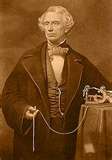
Samuel F. B. Morse
Samuel Finley Breese Morse (April 27, 1791 – April 2, 1872)
was an American inventor, and painter of portraits and historic
scenes; he is most famous for inventing the electric telegraph and
Morse code
Early years
He was born in Charlestown, Massachusetts, the first child of geographer
and pastor Jedidiah Morse and Elizabeth Ann Breese Morse. After
attending Phillips Academy as a child, he attended college at 14.
He devoted himself to art and became a pupil of Washington Allston,
a well-known American painter. While at Yale University, he attended
lectures on electricity from Benjamin Silliman and Jeremiah Day.
He earned money by painting portraits. In 1810, he graduated from
Yale University. Morse later accompanied Allston to Europe in 1811.
Morse in earlier yearsMorse invented a marble-cutting machine that
could carve three dimensional sculptures in marble or stone. Morse
couldn't patent it, however, because of a pre-existing 1820 Thomas
Blanchard design. In 1823, Morse opened an art studio in New York
City. In 1825, Morse painted Marquis de Lafayette's portrait (for
$1,000). On February 7 of that same year, Morse's wife, Lucretia,
died suddenly. She was buried before he returned to New Haven.
Middle years
In 1837, Morse had invented the electrical telegraph, based on
Hans Christian Ørsted's discovery in 1820 of the relationship
between electricity and magnetism. In 1832, Morse developed the
idea of electromagnetic telegraphy, during conversations with Dr.
Charles T. Jackson. (Later, Dr. Jackson would bring a legal case
over the telegraph, which he would ultimately lose.) Morse prototyped
an electromagnetic recording telegraph and dot-and-dash code system
(a signalling alphabet) in his sketchbook.
When studying in Rome in 1830, he became acquainted with the Danish
sculptor Bertel Thorvaldsen; the two artists would sometimes take
walks together at night among the ancient ruins. Morse also painted
Thorvaldsen's portrait. In the fall of 1835, Morse built and demonstrated
a recording telegraph with a moving paper ribbon. At the beginning
of 1836, Morse demonstrated his recording telegraph to Dr. Leonard
Gale. Also in 1836, Morse ran unsuccessfully for Mayor of New York
on a Nativist ticket, receiving 1,496 votes.
In 1836 Morse finished his first working prototype of the telegraph.
It used a one-element battery and a simple electromagnet. This prototype
only worked over short distances of about 40ft or less. In winter
1836-1837 Morse showed his prototype to Leonard Gale, professor
of chemistry at New York University, where Morse taught painting.
Gale was aware of the works of Joseph Henry on electromagnetic relays.
Based on this knowledge Gale suggested several improvements and
also urged Morse to read Henry's 1831 paper, which described these
improvements. With these improvements Morse and Gale were able to
record messages through ten miles of wire. In September of the same
year, Alfred Vail, then student at New York University, witnessed
a demonstration of the telegraph. Vail's father Stephen Vail was
a well-connected tinkerer, inventor, lawyer, community leader, and
technology investor. He helped to finance the work on the telegraph.
International Morse code Chart: a code for each letter.In 1838,
Morse changed the telegraphic cipher, from a telegraphic dictionary
with number code to a code for each letter. Whether Alfred Vail
was the actual inventor of this simpler code has been debated since
the earliest days. According to much of the literature on the subject
Vail was indeed the actual inventor, although Morse and his descendants
claimed otherwise.On January 24, Morse demonstrated the telegraph
to colleges. On February 8, 1838, Morse first publicly demonstrated
the electrical telegraph to a scientific committee at the Franklin
Institute in Philadelphia, Pennsylvania (the first time it worked
was on January 6). On February 21, Morse demonstrated the telegraph
to President Martin Van Buren and his cabinet. Shortly afterwards,
U.S. House of Representatives Committee on Commerce chairman F.
O. J. Smith (Maine) became a partner with Morse (and proposed a
bill in Congress, which didn't pass, for a $30,000 telegraph line
project).
Later years
Portrait of Samuel F. B. Morse by Mathew Brady, between 1855 and
1865In 1839, Morse published (from Paris) the first American description
of daguerreotype photography by Louis Daguerre. Morse pioneered
American daguerreotypes. In 1844 Morse sent the telegraph message
"What hath God wrought?" (Bible, Numbers 23:23) from Washington,
DC to Baltimore, Maryland.In the 1850s, Morse came to Copenhagen
and visited the Thorvaldsen Museum, where the sculptor's grave is
in the inner courtyard. He was received by King Frederick VII, and
he expressed his wish to donate his portrait from 1830 to the king.
The Thorvaldsen portrait today belongs to Queen Margaret II.
The paintings are the excellent portrayal of the events and scenes
that we see around us. The painters are the best cameras of the
world. They reproduce many different types of pictures. They even
draw imaginary pictures that do not exist in this world. We tend
to use both thinned oil paints and dense oil paints. Masterpieces
can be dyed more than once, but each time it may be different from
the existing paintings.h
|
|
|
|
|
| |
| | | | | | | | | | | | |
|
|
|