| |
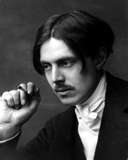
Wyndham Lewis
Wyndham Lewis (November 18, 1882 - March 7, 1957)
was a British painter and author. He was a co-founder of the Vorticist
movement in art, and edited the Vorticists' journal, BLAST (two
numbers, 1914-15). His novels include his pre-World War I-era novel
Tarr (set in Paris),and The Human Age, a trilogy comprising The
Childermass (1928), Monstre Gai and Malign Fiesta (both 1955), set
in the afterworld. A fourth volume of The Human Age, The Trial of
Man, was begun by Lewis but left in a fragmentary state at the time
of his death.
Lewis was born on a yacht off the Canadian province
of Nova Scotia. His mother was British, his father American. He
was educated in England, first at Rugby School, then at the Slade
School of Art in London, before spending most of the 1900s travelling
around Europe and studying art in Paris.
The cover of the 1915 wartime number of the Vorticist
magazine BLAST.It was in the years 1913-15 that he found the painting
style for which he is best known today, a style which his friend
Ezra Pound dubbed Vorticism. Lewis found the strong structure of
Cubist painting appealing, but said it did not seem "alive"
compared to Futurist art, which, conversely, lacked structure. Vorticism
combined these two movements in a strikingly dramatic critique of
modernity. In his early works, particularly versions of village
life in Brittany showing dancers (ca. 1910-12), Lewis was probably
more influenced by the process philosophy of Henri Bergson than
he was later prepared to admit.
After the Vorticists' only exhibition in 1915,
the movement broke up, largely as a result of World War I. Lewis
was posted to the western front, and served as an Official War Artist
1917-1919, painting one of his best known works, A Battery Shelled,
from sketches made on Vimy Ridge. His first novel Tarr was published
in 1918, and is one of the key modernist texts.
By the late 1920s, Lewis was not painting so much,
instead concentrating on writing. His major theoretical and cultural
statement from this period is The Art of Being Ruled (1926, ed.
Dasenbrock, 1989). Time and Western Man (1927)is a cultural and
philosophical discussion that includes a penetrating critique of
James Joyce which is still read. Philosophically, Lewis attacked
the "time philosophy" of Bergson, Alexander and others.
In The Apes of God (1930) he wrote a biting satirical
attack on the Sitwell family, which did not help him to be accepted
into the literary world, and his book Hitler (1931), which was insufficiently
critical of its subject even at this early date, caused him to be
shunned by many. He later wrote The Hitler Cult (1939), a book which
firmly revoked his earlier willingness to entertain Hitler, but
the damage was done, and Lewis was to remain an isolated figure.
In the 1930s Auden called him "that lonely old volcano of the
Right."
However it was during the years 1934-37 that he
wrote The Revenge for Love (1937), about the period before the Spanish
Civil War. Still in print, it is widely regarded as his best novel.
An outstanding book of critical essays belongs to this period; entitled
Men Without Art (1934), it includes one of the first commentaries
on William Faulkner, and a famous essay on Hemingway.
Despite being better known for his writing than
his painting in his later years, paintings from the 1930s and 1940s
constitute some of his best-known work. They are mainly portraits,
and include pictures of Edith Sitwell (1935), T. S. Eliot (1938
and again in 1949) and Ezra Pound (1938). The Surrender of Barcelona
(1936-38) makes a significant statement about the Spanish Civil
War.
Lewis spent World War II in the United States and
Canada. He returned to England in 1945. By 1951, he was completely
blind. In 1950 he published the autobiographical Rude Assignment,
and followed it with the semi-autobiograpical novel Self Condemned,
a major late statement. He died in 1957. Always interested in Roman
Catholicism, he nevertheless never converted. In recent years there
has been a renewal of critical and biographical interest in Lewis
and his work, and he is now regarded as a major British artist and
writer of the twentieth century.
The paintings are the excellent portrayal of the events and scenes
that we see around us. The painters are the best cameras of the
world. They reproduce many different types of pictures. They even
draw imaginary pictures that do not exist in this world. We tend
to use both thinned oil paints and dense oil paints. Masterpieces
can be dyed more than once, but each time it may be different from
the existing paintings.h
|
|
|
|
|
| |
| | | | | | | | | | | | |
|
|
|